It seems like every few months, we go through this again.
In some far-flung locale, or not-so-far-flung, some idiots amass a bunch of explosives or bullets or whatever weapon they can find, and they go about the business of killing a bunch of innocent people, on purpose, with purpose.
The reasons don't really matter. It could be because they don't like abortion. Or they don't like a cartoon somebody published. Or they don't like that their leader was arrested. Or maybe they're crazy.
The reasons don't matter.
The reactions are predictable: Ban the weapon! Ban the religion of the people who did this terrible thing! Ban abortion! Ban cartoons! Build a wall, higher, deeper, more expensive! Bomb Iran! Bomb Syria! Bomb Detroit!
Or: Be reasonable! Not ALL Muslims! Not ALL gun owners! Not ALL cartoonists!
And always: For God's sake, stop this from happening again!
I don't mind saying it: I'm really sort of numb to it. Which, if you think about it, is the only reasonable reaction. (Note that I didn't say it's the only valid reaction.) Terrorism isn't an ideology. It's a tool, often used to promote an ideology. If your reaction to terrorism is to be scared, it's working.
But if you're sitting in your home in Peoria, Illinois, or Hot Springs, Arkansas, or St. George, Utah, and your reaction to a bomb going off in a European airport is to be scared of imminent terrorist action against you...I'm really not sure we can be friends. You seem rather emotionally volatile. In a less sensitive time, you'd be called crazy. Nuts. Off the deep end.
That's really not the point of this blog entry, though. The point is that if you are an adherent to a particular religion, and you think you are somehow better than people who adhere to a different religion, somehow more noble, somehow less prone toward violence in the name of your religion, and on that basis you want to take some aggressive action against the people who adhere to the same religion as the people who are doing the bombing and the murdering, like bombing a country where many of them live or banning them from traveling here, or whatever:
You're part of the problem.
Instead of offering constructive solutions, or introspection, or any of the other things that reasonable, rational, sane people do when confronted with an evil act, you're offering a gross overreaction. Just bomb them. Just ban them. Don't bother looking for causes; act, for God's sake.
For God's sake.
Yeah, as usual, there's the problem.
I'll take the outsider's view, because that's what I am. But this outsider looks at you people, arguing over whose imaginary Supreme Being is real or more powerful or more worthy of worship, to the point of killing each other over it, and I can only ask myself:
What. The. Actual. F---. Is. Wrong. With. You. People?
Look, I get it. You were raised in a religion. (So was I; I saw through it at an early age; I was too weak to admit it for a quarter of a century; it's not too late for you.) You "feel the power." (No, you don't.) You're worried about what happens after you die. (Hint: Nothing.) Or any one of a thousand other reasons why people engage in the grand self-deception that is religion.
Doesn't matter. It's a lie. Your religion, whatever it is, does not make you better than anyone else. Your religion is not a religion of peace. Your religion doesn't justify anything like what you're advocating, and the only reason why you think it does is because you are happy to twist your religion into whatever damn thing you want it to be.
And it doesn't matter if your religion is Christianity, or Islam, or Judaism, or anything else. All of those religions are composed of people. People do bad things. Religious people especially, because they deceive themselves into believing that it matters.
It doesn't matter.
What matters, friends, is how you treat other people. Are you kind to others? Are you helpful? And no, I'm not talking about being "cruel to be kind." I'm not talking about helping others to "find God."
When you're telling President Obama he needs to rain down bombs onto other people, is that a kind thing? Can you put yourself in the shoes of someone who's on the other end of that bomb's trajectory, and say that it's a good thing to do? Do you really think a bomb launched by our military against people in a far-off country is different in any real way from the bomb that was set off in that subway in Brussels?
It's not. And it's time to stop pretending it's different.
And if your religion tells you that it's justifiable, your religion is lying to you.
"But, Jim, you sound angry."
Yeah, I'm angry. I'm angry because all I want is peace, and on one hand I've got idiots who are bombing innocent people, and on the other hand I've got idiots who can't manage to string together a response that reaches beyond "bomb them back."
I'm angry. The better question is, why aren't you?
Wednesday, March 23, 2016

Monday, February 15, 2016
A complicated man
I have resisted the urge, strongly felt since Saturday afternoon when I learned of Antonin Scalia's death, to put any thoughts at all on the screen (I almost said "on paper") about the man and his legacy. I am at best a casual student of the Supreme Court; its work rarely touches on my legal practice, and I have no particular claim to being a scholar of the Constitution and of the court whose work consists primarily in interpreting it.
But Nino Scalia has always been a fascinating and complicated person to me. He was, by all accounts across the spectrum, a brilliant legal scholar. His opinions were enjoyable to read, at least in the sense that they were often funny and ascerbic, with beautifully incisive and insightful commentary. We disagreed about many things, maybe even most things, but I can recognize even in my intellectual opposite that he had a great love for this country and for the Constitution that created and governs it.
I met him once. He was a guest speaker in my Constitutional Law I class at Georgetown in 1998. His commentary came at a time when I was not mature enough to listen to what he had to say, or at least to record it for what it was. He did not call on me for a question, and that's probably a good thing, as I doubt I would have had anything meaningful to ask him, and probably would have used the opportunity to pick a fight with someone who was far better equipped than I was to carry the day. But I remember him being funny, offering jokes and the same wryly-smiling, sarcastic and sardonic demeanor that shines in many of his court opinions. I shook his hand after class and said, "It's an honor to meet you."
He was friendly with Ruth Bader Ginsburg--the best of friends, in fact; they played tennis together, and they both passionately enjoyed the opera--and that, to me, is as good a character reference as one could possibly have. I don't know RBG and although I might have met her once or twice at Georgetown events, I'm sure I've never spoken to her, but her late husband, Martin, taught me nearly everything I know about tax law and policy. He was an amazing teacher who frequently displayed the same sort of wit that Scalia was known for. (This ends the name-dropping portion of the blog post.)
I have no need to write a hagiography of Justice Scalia. In fact, despite everything I've said up to this point, I find it hard to hold him in professional regard at all. He had a carefully cultivated reputation for being what he referred to as a "textualist" when it came to the Constitution--and, for that matter, to all statutory interpretation. By that he meant that the text governs; that the words mean what the words mean, and there is no need of a searching inquiry as to what anyone who wrote them might have meant. (Some confused commentators regard him as an "originalist," a term he flatly rejected for its connotation that what the Framers of the Constitution meant governs; rather, what the text says, governs, in his jurisprudence.)
The problem with that approach is the great divide among Constitutional scholars (and the less scholarly of us): Does the Constitution mean only what it says, in the most restrictive sense, or does it provide a framework of principles that are applied through a process of interpretation? There are merits and demerits on both sides of that divide. I don't fault Scalia for standing on the other side of it. What I fault him for is the quiet abandonment of those principles when they become inconvenient.
That is, Nino wasn't really a textualist at all, except when it conveniently aligned with his sense of where cases should be decided and principles should be applied. He proved as much in his concurring opinion in Bush v. Gore; he wanted Bush to win, so he cobbled together a theory that made that outcome possible.
Likewise, Scalia could be at his most vitriolic when it came to the rights of sexual minorities. His dissent in Lawrence v. Texas, a 2003 that overturned state criminal laws against sodomy, complains loudly about the "homosexual agenda," the focus of which is "eliminating the moral opprobrium that has traditionally attached to homosexual conduct," as though that's something bad. As fine a legal mind as Scalia had, his position on homosexuality illustrates why he was not the kind of Supreme Court justice we need. Above all, the Court must stand ready to protect our hard-won rights as the last bastion of the Constitution against an aggressive government. It is no business of the government what consenting adults do with each other in the privacy of their bedroom. It is simply not something that the government should have any interest in.
Whether he was motivated by a personal dislike for homosexual conduct, or by religious conviction, or by the need to repress personal desires, Scalia's positions that became law worked to oppress millions of Americans and to deprive them of their basic rights and dignities, and those that didn't become law, would have done the same if only more justices had agreed. This illustrates why we must be careful not to follow people just because they are learned, or intelligent, or powerful; their opinions can be wrongheaded despite all of these things; they are subject just as we all are to petty prejudices and lack of foresight. It's important to remember that they are human.
This point is best contained in an aphorism ascribed to Robert H. Jackson, who was the Attorney General under FDR, who was the chief prosecutor for the war crimes trials at Nuremburg, and who held the same seat on the Supreme Court that Scalia held:
I feel sorry for his family, who lost their patriarch this weekend. To them, he wasn't a powerful public figure; he was a husband, a father, a grandfather. They feel his loss deeply, I'm sure. As above, it's important to remember that important, famous, powerful people are human.
But I do not feel sorry for the country, which will be much better off for his absence from the Court.
But Nino Scalia has always been a fascinating and complicated person to me. He was, by all accounts across the spectrum, a brilliant legal scholar. His opinions were enjoyable to read, at least in the sense that they were often funny and ascerbic, with beautifully incisive and insightful commentary. We disagreed about many things, maybe even most things, but I can recognize even in my intellectual opposite that he had a great love for this country and for the Constitution that created and governs it.
I met him once. He was a guest speaker in my Constitutional Law I class at Georgetown in 1998. His commentary came at a time when I was not mature enough to listen to what he had to say, or at least to record it for what it was. He did not call on me for a question, and that's probably a good thing, as I doubt I would have had anything meaningful to ask him, and probably would have used the opportunity to pick a fight with someone who was far better equipped than I was to carry the day. But I remember him being funny, offering jokes and the same wryly-smiling, sarcastic and sardonic demeanor that shines in many of his court opinions. I shook his hand after class and said, "It's an honor to meet you."
He was friendly with Ruth Bader Ginsburg--the best of friends, in fact; they played tennis together, and they both passionately enjoyed the opera--and that, to me, is as good a character reference as one could possibly have. I don't know RBG and although I might have met her once or twice at Georgetown events, I'm sure I've never spoken to her, but her late husband, Martin, taught me nearly everything I know about tax law and policy. He was an amazing teacher who frequently displayed the same sort of wit that Scalia was known for. (This ends the name-dropping portion of the blog post.)
I have no need to write a hagiography of Justice Scalia. In fact, despite everything I've said up to this point, I find it hard to hold him in professional regard at all. He had a carefully cultivated reputation for being what he referred to as a "textualist" when it came to the Constitution--and, for that matter, to all statutory interpretation. By that he meant that the text governs; that the words mean what the words mean, and there is no need of a searching inquiry as to what anyone who wrote them might have meant. (Some confused commentators regard him as an "originalist," a term he flatly rejected for its connotation that what the Framers of the Constitution meant governs; rather, what the text says, governs, in his jurisprudence.)
The problem with that approach is the great divide among Constitutional scholars (and the less scholarly of us): Does the Constitution mean only what it says, in the most restrictive sense, or does it provide a framework of principles that are applied through a process of interpretation? There are merits and demerits on both sides of that divide. I don't fault Scalia for standing on the other side of it. What I fault him for is the quiet abandonment of those principles when they become inconvenient.
That is, Nino wasn't really a textualist at all, except when it conveniently aligned with his sense of where cases should be decided and principles should be applied. He proved as much in his concurring opinion in Bush v. Gore; he wanted Bush to win, so he cobbled together a theory that made that outcome possible.
Likewise, Scalia could be at his most vitriolic when it came to the rights of sexual minorities. His dissent in Lawrence v. Texas, a 2003 that overturned state criminal laws against sodomy, complains loudly about the "homosexual agenda," the focus of which is "eliminating the moral opprobrium that has traditionally attached to homosexual conduct," as though that's something bad. As fine a legal mind as Scalia had, his position on homosexuality illustrates why he was not the kind of Supreme Court justice we need. Above all, the Court must stand ready to protect our hard-won rights as the last bastion of the Constitution against an aggressive government. It is no business of the government what consenting adults do with each other in the privacy of their bedroom. It is simply not something that the government should have any interest in.
Whether he was motivated by a personal dislike for homosexual conduct, or by religious conviction, or by the need to repress personal desires, Scalia's positions that became law worked to oppress millions of Americans and to deprive them of their basic rights and dignities, and those that didn't become law, would have done the same if only more justices had agreed. This illustrates why we must be careful not to follow people just because they are learned, or intelligent, or powerful; their opinions can be wrongheaded despite all of these things; they are subject just as we all are to petty prejudices and lack of foresight. It's important to remember that they are human.
This point is best contained in an aphorism ascribed to Robert H. Jackson, who was the Attorney General under FDR, who was the chief prosecutor for the war crimes trials at Nuremburg, and who held the same seat on the Supreme Court that Scalia held:
We are not final because we are infallible, but we are infallible only because we are final.
I feel sorry for his family, who lost their patriarch this weekend. To them, he wasn't a powerful public figure; he was a husband, a father, a grandfather. They feel his loss deeply, I'm sure. As above, it's important to remember that important, famous, powerful people are human.
But I do not feel sorry for the country, which will be much better off for his absence from the Court.
Friday, February 5, 2016
What is socialism?
I was on the phone the other day, a business call in which I was providing tech support for one of my web hosting clients. I was scanning a log to try to pinpoint the problem the client was having, so I put the phone down. I could hear the client and one of his employees chatting, and the subject of the Iowa caucuses came up.
The employee said she was having trouble making up her mind about the candidates, and Bernie Sanders came up. The client shut that down quickly: "He's a socialist, so no thanks."
For most people, "socialist" has certain connotations. Most people have only a superficial understanding of the term. We all learned in school about the Union of Soviet Socialist Republics, and, depending on your age, we knew that people like Mao and Stalin and Khrushchev and Castro were tied up in socialism somehow, and those guys were bad, so socialism is a bad thing, right?
You might even remember that the term "Nazi" is short for Nationalsozialistische Deutsche Arbeiterpartei, which is German for "National Socialist German Workers' Party." And the Nazis were the worst of the bad, so socialism is a really bad thing, right?
I'm sure that the handful of people who read this blog know that just because something is called by a certain name, doesn't mean that everything called by that name is the same thing. For example, the Democratic Party, of which I am a proud member, takes certain political positions on social and economic issues, while the Arkansas Democrat-Gazette newspaper stands squarely opposed to virtually all of those positions.
Of course, it's difficult to imagine two more different systems than the one in Nazi Germany and the one in Soviet Russia. The Nazis were fascists--radical authoritarian nationalists--who viewed the state as being more important than the people; all effort was to be given in service of the government and of the purity of the "German race."
The USSR and Mao's China and Cuba under Castro were all communist governments. Communism generally means an economic system in which property is owned by the state and the economy is planned and controlled centrally by the government, but the focus is on the equality of the people, en masse. When you operate in a communist economy, you can't start a business (at least not without the permission of the government); rather, you're assigned a job and you're paid according to what (in theory) your needs happen to be. The state is merely an instrument to plan and enforce small-scale economic equality of people.
The problem with the communist arrangement is that it tends not to work very well on the large scale. (It works exceptionally well on the family scale; in most families, children receive what they need and contribute according to their abilities, while the adult(s) work to provide for those who can't provide for themselves. This is a good example, by the way, of why thinking about the government's budget in the same way that we think about a family budget is a terrible idea.) So the USSR broke up and the resulting parts mostly adopted capitalism; China's economy has become capitalist in many respects; Cuba is...well, it's still socialismo o muerte down there, but they're so hungry that they'll take what they can get.
The problems with fascism are self-evident.
In reality, neither of these systems really reflects the sort of socialism that Bernie Sanders advocates for. Specifically, he qualifies the term "socialist" with the term "democratic." But if you look at what he is advocating for, it doesn't really look all that different from the U.S. economy between 1935 and 1965--a time when we faced and conquered some of the greatest challenges that any country has ever seen, and when we enjoyed the most broad-based prosperity any society in the history of the world has ever enjoyed.
I am a capitalist. I own my own businesses. I believe that fair markets are the best way of allocating goods and services in the economy. I strongly believe in the right of individuals to make their own economic choices.
But anyone who says that our capitalist economy is not also socialist is a fool.
There is very little I could do--very little any of us could do--without the socialist influence on our economy. For example, every day, I get in my capitalist shower and turn on the socialist clean water tap; I dress in capitalist clothes, eat a breakfast made safe by socialist regulations; I get in my capitalist car (with socialist safety features and fuel economy standards) and pull out of my driveway onto a socialist street, controlled by socialist traffic signals, onto the socialist freeway, and park in my capitalist parking lot, ride the elevator (made safe by socialist regulations) to my floor, turn on my capitalist computer powered by socialist electricity (think REA and Corps of Engineers hydropower), communicate via the socialist internet, send letters via the socialist mail service...I could go on and on, but I think you get the point.
What I do, what we all do for a living is radically influenced, if not outright enabled, by a government that smooths the path for us. The government invests in things that are difficult or impossible for individuals to accomplish on their own, like roads, and water and sewer systems, and electrical infrastructure, and national defense, and food safety, and police and fire protection. It also arranges for Social Security and Medicare to make it easier for people to live after they have outlived their ability to earn a living.
All of these things are "socialist." And yet they do not exist in opposition to capitalism; they do not work against capitalism; they work alongside capitalism; and, perhaps most importantly, they make capitalism possible.
It's not free to do these things. They cost money, whether you do them with private investment or public investment. But just like borrowing money to buy a house or a car, they represent investments that make life easier and more productive than without them.
This is not some "pie in the sky" "free money and stuff for everybody" concept. It is part of our social bargain. By investing in college, we make it easier for the younger generation to reach their potential without incurring ruinous debt, so that they can get good jobs and become taxpayers. By investing in a health care system that works--Medicare for All--we can save most people a lot of money by making private health insurance unnecessary. These are things that most countries--including the most successful economies in the world--do already. They can work here, because they have worked here before, and far from destroying our economy, they made it the envy of the world.
The employee said she was having trouble making up her mind about the candidates, and Bernie Sanders came up. The client shut that down quickly: "He's a socialist, so no thanks."
For most people, "socialist" has certain connotations. Most people have only a superficial understanding of the term. We all learned in school about the Union of Soviet Socialist Republics, and, depending on your age, we knew that people like Mao and Stalin and Khrushchev and Castro were tied up in socialism somehow, and those guys were bad, so socialism is a bad thing, right?
You might even remember that the term "Nazi" is short for Nationalsozialistische Deutsche Arbeiterpartei, which is German for "National Socialist German Workers' Party." And the Nazis were the worst of the bad, so socialism is a really bad thing, right?
I'm sure that the handful of people who read this blog know that just because something is called by a certain name, doesn't mean that everything called by that name is the same thing. For example, the Democratic Party, of which I am a proud member, takes certain political positions on social and economic issues, while the Arkansas Democrat-Gazette newspaper stands squarely opposed to virtually all of those positions.
Of course, it's difficult to imagine two more different systems than the one in Nazi Germany and the one in Soviet Russia. The Nazis were fascists--radical authoritarian nationalists--who viewed the state as being more important than the people; all effort was to be given in service of the government and of the purity of the "German race."
The USSR and Mao's China and Cuba under Castro were all communist governments. Communism generally means an economic system in which property is owned by the state and the economy is planned and controlled centrally by the government, but the focus is on the equality of the people, en masse. When you operate in a communist economy, you can't start a business (at least not without the permission of the government); rather, you're assigned a job and you're paid according to what (in theory) your needs happen to be. The state is merely an instrument to plan and enforce small-scale economic equality of people.
The problem with the communist arrangement is that it tends not to work very well on the large scale. (It works exceptionally well on the family scale; in most families, children receive what they need and contribute according to their abilities, while the adult(s) work to provide for those who can't provide for themselves. This is a good example, by the way, of why thinking about the government's budget in the same way that we think about a family budget is a terrible idea.) So the USSR broke up and the resulting parts mostly adopted capitalism; China's economy has become capitalist in many respects; Cuba is...well, it's still socialismo o muerte down there, but they're so hungry that they'll take what they can get.
The problems with fascism are self-evident.
In reality, neither of these systems really reflects the sort of socialism that Bernie Sanders advocates for. Specifically, he qualifies the term "socialist" with the term "democratic." But if you look at what he is advocating for, it doesn't really look all that different from the U.S. economy between 1935 and 1965--a time when we faced and conquered some of the greatest challenges that any country has ever seen, and when we enjoyed the most broad-based prosperity any society in the history of the world has ever enjoyed.
I am a capitalist. I own my own businesses. I believe that fair markets are the best way of allocating goods and services in the economy. I strongly believe in the right of individuals to make their own economic choices.
But anyone who says that our capitalist economy is not also socialist is a fool.
There is very little I could do--very little any of us could do--without the socialist influence on our economy. For example, every day, I get in my capitalist shower and turn on the socialist clean water tap; I dress in capitalist clothes, eat a breakfast made safe by socialist regulations; I get in my capitalist car (with socialist safety features and fuel economy standards) and pull out of my driveway onto a socialist street, controlled by socialist traffic signals, onto the socialist freeway, and park in my capitalist parking lot, ride the elevator (made safe by socialist regulations) to my floor, turn on my capitalist computer powered by socialist electricity (think REA and Corps of Engineers hydropower), communicate via the socialist internet, send letters via the socialist mail service...I could go on and on, but I think you get the point.
What I do, what we all do for a living is radically influenced, if not outright enabled, by a government that smooths the path for us. The government invests in things that are difficult or impossible for individuals to accomplish on their own, like roads, and water and sewer systems, and electrical infrastructure, and national defense, and food safety, and police and fire protection. It also arranges for Social Security and Medicare to make it easier for people to live after they have outlived their ability to earn a living.
All of these things are "socialist." And yet they do not exist in opposition to capitalism; they do not work against capitalism; they work alongside capitalism; and, perhaps most importantly, they make capitalism possible.
It's not free to do these things. They cost money, whether you do them with private investment or public investment. But just like borrowing money to buy a house or a car, they represent investments that make life easier and more productive than without them.
This is not some "pie in the sky" "free money and stuff for everybody" concept. It is part of our social bargain. By investing in college, we make it easier for the younger generation to reach their potential without incurring ruinous debt, so that they can get good jobs and become taxpayers. By investing in a health care system that works--Medicare for All--we can save most people a lot of money by making private health insurance unnecessary. These are things that most countries--including the most successful economies in the world--do already. They can work here, because they have worked here before, and far from destroying our economy, they made it the envy of the world.
Monday, January 4, 2016
Patterns
I was never very good at the child's game in which you look up at clouds and describe them using familiar shapes. I could see the rabbit or the turtle or the birthday cake, but it just wasn't very interesting to me to imagine these things, and I would quickly become bored.
You might call that a failure of imagination, or it might be something else--maybe just an unwillingness to pretend to see things that weren't there.
One of the most famous commercial failures in history was the Edsel, not a single model of the Ford Motor Company, but its own division, much like Mercury and Lincoln, and four models. Edsels were fine enough cars--they did suffer from reliability issues mostly stemming from the division's innovative but underthought or underexecuted engineering--but they failed to sell and nearly took Ford straight out of business. The failure of the Edsel has been the subject of much study. One leading theory has to do with the vehicles' styling, particularly the front-end grille. The novel shape of the grille, internally at Ford referred to as the "horse collar" design, reminded folks of a rather different shape: female genitals.
Vulgarities aside, we can look at the front of most cars these days and see a "face," of course. But why?
One of the continually amazing aspects of the human brain is its ability to engage in pattern recognition. In fact, that might be the single most important aspect of our evolutionary development.
If you show a dog a cartoon drawing of a dog, the dog won't recognize it as a dog. If you show the same dog a photograph of a dog, there is a fair chance that the dog will recognize the image as being that of a dog.
Show a person a cartoon drawing of a dog--even the most dull-witted of people, and even young children--and that person will recognize it as a dog. Our human brains are highly capable, almost instinctively, of the sort of analysis that's necessary to analogize a cartoon drawing to a real-life dog, because our brains are conditioned through millions of years of evolutionary development to make judgments about what sort of thing we are perceiving even though we may have only directly perceived a limited amount of information about it.
That ability confers an evolutionary advantage in a dangerous world for a couple of reasons. Being able to perceive dangers quickly enough to avoid them, even with limited information, means that those with this ability are more likely to survive to reproduce. Being able to use limited information to identify food sources or to identify members of your own social group does much the same thing.
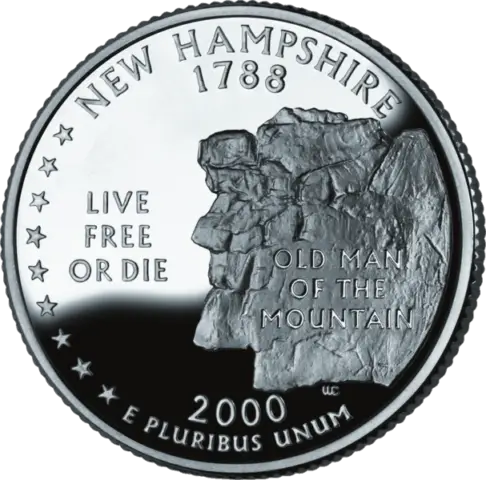 Some years ago, the U.S. Mint put out a series of commemorative quarters, one per state, and each state was allowed some freedom to present a design for the reverse of the quarter that symbolized the state. The state quarter for New Hampshire depicts the Old Man of the Mountain, a granite outcropping from Cannon Mountain composed of a series of ledges that, viewed in profile, resemble an old man's face.
The Old Man of the Mountain collapsed in 2003, so it is no longer available to be seen in person. Unlike Mount Rushmore, which includes manmade carvings of the heads of four presidents, the Old Man of the Mountain was an entirely natural landform. It takes imagination and pattern-recognition to be able to "see" the face.

Another image made the rounds on social media a few years ago. A large American flag was erected in the parking lot of a Fry's grocery store in Yuma, Arizona, suspended between two cranes, on September 12, 2001. Backlit by the rising sun, the flag was partially translucent, and it gave the impression of a Christian cross within the flag's blue field. This image was said to be symbolic of the U.S. being "one nation under God."
 If you'll permit me one more example from social media, I'll get to the point. A photo made the rounds on Facebook about the time that the movie American Sniper was in theaters. The photo is of a cumulonimbus cloud in the distance, perched over a mountainous horizon, and it is not difficult to see in that cloudform a sniper looking through a scoped rifle.
None of these images are anything more than coincidence and perception, of course. The cross-flag in particular is simply the product of back-lighting a woven fabric, plus an eager Christian looking for symbols that meet his or her prejudices. (If the shape of the weave had produced a crescent, do you think this person would have reached a similar conclusion about Islam?)
I have spent a great deal of time lately thinking about why it is that people are so eager to conclude that there is a God that intervenes frequently in our lives. It is relatively easy to see that rock outcroppings and the Moon don't really have human faces, or that a cloudform isn't actually a sniper or a frog or a rabbit. But what of the folks who claim, in all seriousness, that God is responsible for everything that happens in our lives, from the mundane ("I found a twenty-dollar bill in my coat pocket! Thank God!") to the serious ("My child was in a car hit by a drunk driver and in critical condition. Please pray for her")? What makes that concept so attractive to people, when there doesn't seem to be anything more than random chance at work?
I have to conclude that this is the result of a craving for patterns. We crave a deterministic universe, where known stimuli produce known results, where we can push this or that lever, metaphorically speaking, and get this or that predictable result. We fear the unknown, so we find comfort in the hope that someone--someone powerful, whom we imagine to be on our side--is really in control and working for our benefit.
If something bad happens, we can hope that the consequences will be somehow mitigated. My mother has cancer. Please pray for her healing.
If something good happens, we can attribute it to this mysterious force that loves us. I got a new job today, so thanks for your prayers--they really worked.
There is no bigger unknown than death. If you do this thing, then death won't really be the end of you, and you will live in a paradise unlike you've ever known.
This concept dominates most of the religions I have ever learned about. Judaism is one religion, at least in its modern practice, that doesn't seem to be dominated by it, but it is nonetheless a significant component of that religion. Christianity, particularly evangelical Christianity, is so thoroughly subsumed by this concept that virtually nothing else matters.
Why do these people in particular spend so much time attempting to divine the "will of God" based on what happens? Is the idea that bad things and good things happen because of the circumstances of their occurrence, and not because someone is behind the scenes pushing and pulling levers, really so frightening?
Some of you might be thinking, well, what could it hurt? And I get that. I can't definitively say that there is no God. I can only say that I have never seen any real evidence of one. If one exists, there are a lot of unresolved contradictions that don't seem to have a solution. But it turns out that it can hurt. Wishing that there were a God to save us from misfortune, from pain, from death, doesn't make it so. Concluding that misfortune, pain, or death is the result of lacking God's favor, when in reality those things are just random occurrences--well, that is harmful, psychologically. Trusting in God to save you when your own action would be more likely to do so--that's harmful. Praying instead of doing--that's harmful.
One of my favorite things to say--something I'll expand on a bit, today--is that even though we live in a universe that is capable of crushing us without a second thought, even though our world is fraught with perils, the likes of which we cannot even really begin to perceive, the major cause of our misfortune has nothing to do with these things in most cases. Sure, we might not know what precisely causes someone to get cancer and someone else not to. But there are many things that are capable of killing us, that don't, and we live out our merry lives in blissful ignorance.
What often causes us the most pain, the most strife, the most heartache, the most loss, isn't what we don't know. It's the thing of which we are absolutely sure, that simply isn't so. That's what kills you, literally or figuratively.*
* - One of my favorite examples of this is the insistence on the part of many evangelical Christians that humans could not possibly be responsible for global warming, because, they conclude, God would not allow us to destroy His creation. Because they are so absolutely sure of this, they believe it's unnecessary to do anything to counteract the global warming we're actually observing, even though it will almost certainly lead to devastating consequences for millions if not billions of people.
The late Christopher Hitchens, an avowed atheist, famously stated, "Religion poisons everything." He was right. There are lots of people who are supposedly inspired by their religion to do good works. When a Christian does something great or helpful for his fellow human, he and we are quick to attribute it to the powerful force of religion in his life. But I doubt very seriously that if you subtracted Christianity from the equation, it would make this great or helpful thing less great or less helpful, or that it would be the great or helpful thing disappear entirely--and if it did disappear entirely, what does it say about this supposedly great human being? That he can't be bothered to do right by his fellow human beings except on promise of some reward in the afterlife?
The truth is that we do the things that we do because we see them as right, on balance; then we fix the reasons around them as needed. Very few people do knowing wrong. They may do wrong, knowing that it is abstractly wrong, but justifying it by some greater good that they perceive, even if it's a personal good.
As most of you know, I enjoy playing pub trivia. I have been fortunate enough to win with some regularity. On at least two occasions, I have been credited with more points than I actually earned. I have polled some of my friends about that situation. Some of them say they would correct the score, even if it put them in a worse position. Some of them say they would keep their mouths shut.
When it happens, as it does from time to time, my decision has always been to give back the points. I have my reasons--take your pick: I win often enough without help that I don't need "help" when it comes like that; it's not fair to the other teams; if someone else got that sort of advantage over me, I'd want them to give the points back. But I could just as easily conclude that few people would give back points; that I'm handicapping myself not to take the "help" when it's my "turn," as it randomly would be from time to time; or that I simply like winning. I can't say that any of these reasons, pro or con, is inherently wrong. I can't say that pushing or pulling any given lever produces the "right" result.
But what I can say is that you can inject religion into that situation all you like, and it's not going to resolve the question. We might apply the Golden Rule, that principle common to all religions, but we might also conclude, with equal evidence and force and sincerity, that if God didn't want us to win, He wouldn't have allowed the mistake to be made.
And that's one of the more pernicious ways that religion, or at least this concept of an intermeddling God, this indecipherable pattern-maker, poisons things--by convincing us that everything happens for a reason, according to a pattern or plan, and who are we to question the good fortune we've had?
Taken to the extreme, we can see it in the modern evangelists' fundraising, whether it's Oral Roberts claiming that God commanded him to kill himself if he didn't raise $8 million for a new building, or Creflo Dollar seeking $65 million for a private jet, or Joel Osteen preaching that prosperity is a gift that God bestows upon the righteous.
God didn't want Oral Roberts to have a new building; Oral Roberts wanted a new building, and pretending that God wanted it on pain of Roberts's death was just the mechanism for getting there.
God didn't want Creflo Dollar to have a $65 million plane; Creflo Dollar wanted a $65 million plane; God was just the mechanism for getting it.
God doesn't give prosperity in exchange for righteousness. Joel Osteen wants a 10,000-square-foot house and a plane and fancy cars, and rich people want to be told that they deserve what they have, so they buy Osteen a big house and a plane and fancy cars.
God doesn't save your grandma from cancer; that's a surgeon or an oncologist, or maybe she won't be saved at all.
God doesn't heal the hole in your baby's heart; that's a cardiologist, or maybe your baby's body heals itself, or maybe she won't be healed.
God didn't put that $20 bill in your winter coat; you did, last spring, when you put it up for the last time, and forgot about it.
And God doesn't help you find your car keys, or put cross symbols in flags, or get you a new job. These things happen by chance. Or because you work hard and educate yourself. Or because you hit on that combination of things that produces the result you want.
And when you die, that's it. God isn't there to tell you, "OK, just kidding, here's eternal life."
So don't waste the life you have looking for patterns.
There aren't any patterns, not of this type. And seeing them, or being able to see them, doesn't mean they exist.
CODA: It's not that I see no use for religion. We humans are fragile. We are capable of so much, but we are equally capable of being taken down by our own foibles and follies. If you need religion to cope with the overwhelming reality of life, then, by all means, have religion. If you need to make a pattern that includes you not drinking or doing drugs, or otherwise engaging in destructive behavior, and religion helps you do that, I'm not going to stand in your way. But most folks would do just fine without it, and plenty of folks don't do well with it. So if you can be good without God, go ahead.
You might call that a failure of imagination, or it might be something else--maybe just an unwillingness to pretend to see things that weren't there.
One of the most famous commercial failures in history was the Edsel, not a single model of the Ford Motor Company, but its own division, much like Mercury and Lincoln, and four models. Edsels were fine enough cars--they did suffer from reliability issues mostly stemming from the division's innovative but underthought or underexecuted engineering--but they failed to sell and nearly took Ford straight out of business. The failure of the Edsel has been the subject of much study. One leading theory has to do with the vehicles' styling, particularly the front-end grille. The novel shape of the grille, internally at Ford referred to as the "horse collar" design, reminded folks of a rather different shape: female genitals.
.jpg) |
| As the joke went, "Put a little hair around it and you'd have an "Ethel." |
Vulgarities aside, we can look at the front of most cars these days and see a "face," of course. But why?
One of the continually amazing aspects of the human brain is its ability to engage in pattern recognition. In fact, that might be the single most important aspect of our evolutionary development.
If you show a dog a cartoon drawing of a dog, the dog won't recognize it as a dog. If you show the same dog a photograph of a dog, there is a fair chance that the dog will recognize the image as being that of a dog.
Show a person a cartoon drawing of a dog--even the most dull-witted of people, and even young children--and that person will recognize it as a dog. Our human brains are highly capable, almost instinctively, of the sort of analysis that's necessary to analogize a cartoon drawing to a real-life dog, because our brains are conditioned through millions of years of evolutionary development to make judgments about what sort of thing we are perceiving even though we may have only directly perceived a limited amount of information about it.
That ability confers an evolutionary advantage in a dangerous world for a couple of reasons. Being able to perceive dangers quickly enough to avoid them, even with limited information, means that those with this ability are more likely to survive to reproduce. Being able to use limited information to identify food sources or to identify members of your own social group does much the same thing.
The Old Man of the Mountain collapsed in 2003, so it is no longer available to be seen in person. Unlike Mount Rushmore, which includes manmade carvings of the heads of four presidents, the Old Man of the Mountain was an entirely natural landform. It takes imagination and pattern-recognition to be able to "see" the face.
Another image made the rounds on social media a few years ago. A large American flag was erected in the parking lot of a Fry's grocery store in Yuma, Arizona, suspended between two cranes, on September 12, 2001. Backlit by the rising sun, the flag was partially translucent, and it gave the impression of a Christian cross within the flag's blue field. This image was said to be symbolic of the U.S. being "one nation under God."
None of these images are anything more than coincidence and perception, of course. The cross-flag in particular is simply the product of back-lighting a woven fabric, plus an eager Christian looking for symbols that meet his or her prejudices. (If the shape of the weave had produced a crescent, do you think this person would have reached a similar conclusion about Islam?)
I have spent a great deal of time lately thinking about why it is that people are so eager to conclude that there is a God that intervenes frequently in our lives. It is relatively easy to see that rock outcroppings and the Moon don't really have human faces, or that a cloudform isn't actually a sniper or a frog or a rabbit. But what of the folks who claim, in all seriousness, that God is responsible for everything that happens in our lives, from the mundane ("I found a twenty-dollar bill in my coat pocket! Thank God!") to the serious ("My child was in a car hit by a drunk driver and in critical condition. Please pray for her")? What makes that concept so attractive to people, when there doesn't seem to be anything more than random chance at work?
I have to conclude that this is the result of a craving for patterns. We crave a deterministic universe, where known stimuli produce known results, where we can push this or that lever, metaphorically speaking, and get this or that predictable result. We fear the unknown, so we find comfort in the hope that someone--someone powerful, whom we imagine to be on our side--is really in control and working for our benefit.
If something bad happens, we can hope that the consequences will be somehow mitigated. My mother has cancer. Please pray for her healing.
If something good happens, we can attribute it to this mysterious force that loves us. I got a new job today, so thanks for your prayers--they really worked.
There is no bigger unknown than death. If you do this thing, then death won't really be the end of you, and you will live in a paradise unlike you've ever known.
This concept dominates most of the religions I have ever learned about. Judaism is one religion, at least in its modern practice, that doesn't seem to be dominated by it, but it is nonetheless a significant component of that religion. Christianity, particularly evangelical Christianity, is so thoroughly subsumed by this concept that virtually nothing else matters.
Why do these people in particular spend so much time attempting to divine the "will of God" based on what happens? Is the idea that bad things and good things happen because of the circumstances of their occurrence, and not because someone is behind the scenes pushing and pulling levers, really so frightening?
Some of you might be thinking, well, what could it hurt? And I get that. I can't definitively say that there is no God. I can only say that I have never seen any real evidence of one. If one exists, there are a lot of unresolved contradictions that don't seem to have a solution. But it turns out that it can hurt. Wishing that there were a God to save us from misfortune, from pain, from death, doesn't make it so. Concluding that misfortune, pain, or death is the result of lacking God's favor, when in reality those things are just random occurrences--well, that is harmful, psychologically. Trusting in God to save you when your own action would be more likely to do so--that's harmful. Praying instead of doing--that's harmful.
One of my favorite things to say--something I'll expand on a bit, today--is that even though we live in a universe that is capable of crushing us without a second thought, even though our world is fraught with perils, the likes of which we cannot even really begin to perceive, the major cause of our misfortune has nothing to do with these things in most cases. Sure, we might not know what precisely causes someone to get cancer and someone else not to. But there are many things that are capable of killing us, that don't, and we live out our merry lives in blissful ignorance.
What often causes us the most pain, the most strife, the most heartache, the most loss, isn't what we don't know. It's the thing of which we are absolutely sure, that simply isn't so. That's what kills you, literally or figuratively.*
* - One of my favorite examples of this is the insistence on the part of many evangelical Christians that humans could not possibly be responsible for global warming, because, they conclude, God would not allow us to destroy His creation. Because they are so absolutely sure of this, they believe it's unnecessary to do anything to counteract the global warming we're actually observing, even though it will almost certainly lead to devastating consequences for millions if not billions of people.
The late Christopher Hitchens, an avowed atheist, famously stated, "Religion poisons everything." He was right. There are lots of people who are supposedly inspired by their religion to do good works. When a Christian does something great or helpful for his fellow human, he and we are quick to attribute it to the powerful force of religion in his life. But I doubt very seriously that if you subtracted Christianity from the equation, it would make this great or helpful thing less great or less helpful, or that it would be the great or helpful thing disappear entirely--and if it did disappear entirely, what does it say about this supposedly great human being? That he can't be bothered to do right by his fellow human beings except on promise of some reward in the afterlife?
The truth is that we do the things that we do because we see them as right, on balance; then we fix the reasons around them as needed. Very few people do knowing wrong. They may do wrong, knowing that it is abstractly wrong, but justifying it by some greater good that they perceive, even if it's a personal good.
As most of you know, I enjoy playing pub trivia. I have been fortunate enough to win with some regularity. On at least two occasions, I have been credited with more points than I actually earned. I have polled some of my friends about that situation. Some of them say they would correct the score, even if it put them in a worse position. Some of them say they would keep their mouths shut.
When it happens, as it does from time to time, my decision has always been to give back the points. I have my reasons--take your pick: I win often enough without help that I don't need "help" when it comes like that; it's not fair to the other teams; if someone else got that sort of advantage over me, I'd want them to give the points back. But I could just as easily conclude that few people would give back points; that I'm handicapping myself not to take the "help" when it's my "turn," as it randomly would be from time to time; or that I simply like winning. I can't say that any of these reasons, pro or con, is inherently wrong. I can't say that pushing or pulling any given lever produces the "right" result.
But what I can say is that you can inject religion into that situation all you like, and it's not going to resolve the question. We might apply the Golden Rule, that principle common to all religions, but we might also conclude, with equal evidence and force and sincerity, that if God didn't want us to win, He wouldn't have allowed the mistake to be made.
And that's one of the more pernicious ways that religion, or at least this concept of an intermeddling God, this indecipherable pattern-maker, poisons things--by convincing us that everything happens for a reason, according to a pattern or plan, and who are we to question the good fortune we've had?
Taken to the extreme, we can see it in the modern evangelists' fundraising, whether it's Oral Roberts claiming that God commanded him to kill himself if he didn't raise $8 million for a new building, or Creflo Dollar seeking $65 million for a private jet, or Joel Osteen preaching that prosperity is a gift that God bestows upon the righteous.
God didn't want Oral Roberts to have a new building; Oral Roberts wanted a new building, and pretending that God wanted it on pain of Roberts's death was just the mechanism for getting there.
God didn't want Creflo Dollar to have a $65 million plane; Creflo Dollar wanted a $65 million plane; God was just the mechanism for getting it.
God doesn't give prosperity in exchange for righteousness. Joel Osteen wants a 10,000-square-foot house and a plane and fancy cars, and rich people want to be told that they deserve what they have, so they buy Osteen a big house and a plane and fancy cars.
God doesn't save your grandma from cancer; that's a surgeon or an oncologist, or maybe she won't be saved at all.
God doesn't heal the hole in your baby's heart; that's a cardiologist, or maybe your baby's body heals itself, or maybe she won't be healed.
God didn't put that $20 bill in your winter coat; you did, last spring, when you put it up for the last time, and forgot about it.
And God doesn't help you find your car keys, or put cross symbols in flags, or get you a new job. These things happen by chance. Or because you work hard and educate yourself. Or because you hit on that combination of things that produces the result you want.
And when you die, that's it. God isn't there to tell you, "OK, just kidding, here's eternal life."
So don't waste the life you have looking for patterns.
There aren't any patterns, not of this type. And seeing them, or being able to see them, doesn't mean they exist.
* * * * *
CODA: It's not that I see no use for religion. We humans are fragile. We are capable of so much, but we are equally capable of being taken down by our own foibles and follies. If you need religion to cope with the overwhelming reality of life, then, by all means, have religion. If you need to make a pattern that includes you not drinking or doing drugs, or otherwise engaging in destructive behavior, and religion helps you do that, I'm not going to stand in your way. But most folks would do just fine without it, and plenty of folks don't do well with it. So if you can be good without God, go ahead.
Wednesday, December 2, 2015
It didn't happen
I don't like talking about Donald Trump, but I have to say that I understand why he believes there were mass celebrations among American Muslims when 9/11 happened. To someone with his mindset, it just feels like it might be true. It's not surprising that people would step up to defend him, "remembering" these things that didn't happen, and desperately clinging to anything they can find, no matter how far-fetched or undocumented, that supports the position.
The conservative media are leading the charge to prove his position, going so far as to pronounce the pushback Trump has gotten to be the product of their usual bogeyman: a conspiracy of the Liberal Media.
But let's be honest: While there may have been very isolated examples of American Muslims (or non-American Muslims who happen to live here) celebrating what happened on 9/11, there were no mass celebrations, no swarms of thousands of Muslims dancing and celebrating in American streets. Such activities would have been documented in a lasting fashion; it would not be necessary to comb through news reports hoping to find nuggets of support.
The reason why we know this is because in the days following 9/11, the government began detaining Muslims, mostly men, whom it deemed to pose a threat to national security. These men were frequently held for long periods without access to family or attorneys, in undisclosed locations. In a political climate that would permit the *government* to engage in these decidedly un-American activities, it is simply not credible to believe that thousands of American Muslims could celebrate 9/11 so openly that Donald Trump could see them doing so on television, yet no video of those activities survives even 14 years after the fact.
The American Muslims I know were horrified at what happened on 9/11, not because of what they surely knew would bring retribution heavily down on them, but because what happened on 9/11 was a crime against all humanity, including themselves.
I have said it many times: The human brain is an amazing thing, capable of great intellect and reason, but dangerously capable of self-deception. Memory, particularly long memory, is untrustworthy, because it can be distorted by emotion and imagination. In one prominent example, many people remember the famous shower scene in the Hitchcock film Psycho for its vivid red blood, running down the shower drain. It's a shocking scene, one of the greatest in cinematic history. But the people who "remember" red blood in that scene are wrong. In reality, Psycho was filmed in black-and-white. In reality, the filmmakers used Hershey's syrup, which of course is brown. In reality, no one saw red blood, or red anything, in Psycho--but many people "remember" it that way.
Wanting to believe something happened makes it easier to "remember" it.
This is not a media conspiracy against Donald Trump. He is simply wrong about what he remembers. That's a human-enough error that can be excused on its merits. But what we should be more vigilant about is not the "what," but the "why." Why does it matter? What is the importance of "knowing" that American Muslims celebrated 9/11? If you falsely believe that they did, what are you going to do with that information? Are you using it to feed hatred in your heart toward people who have literally done nothing to you? That can't be a good idea.
The conservative media are leading the charge to prove his position, going so far as to pronounce the pushback Trump has gotten to be the product of their usual bogeyman: a conspiracy of the Liberal Media.
But let's be honest: While there may have been very isolated examples of American Muslims (or non-American Muslims who happen to live here) celebrating what happened on 9/11, there were no mass celebrations, no swarms of thousands of Muslims dancing and celebrating in American streets. Such activities would have been documented in a lasting fashion; it would not be necessary to comb through news reports hoping to find nuggets of support.
The reason why we know this is because in the days following 9/11, the government began detaining Muslims, mostly men, whom it deemed to pose a threat to national security. These men were frequently held for long periods without access to family or attorneys, in undisclosed locations. In a political climate that would permit the *government* to engage in these decidedly un-American activities, it is simply not credible to believe that thousands of American Muslims could celebrate 9/11 so openly that Donald Trump could see them doing so on television, yet no video of those activities survives even 14 years after the fact.
The American Muslims I know were horrified at what happened on 9/11, not because of what they surely knew would bring retribution heavily down on them, but because what happened on 9/11 was a crime against all humanity, including themselves.
I have said it many times: The human brain is an amazing thing, capable of great intellect and reason, but dangerously capable of self-deception. Memory, particularly long memory, is untrustworthy, because it can be distorted by emotion and imagination. In one prominent example, many people remember the famous shower scene in the Hitchcock film Psycho for its vivid red blood, running down the shower drain. It's a shocking scene, one of the greatest in cinematic history. But the people who "remember" red blood in that scene are wrong. In reality, Psycho was filmed in black-and-white. In reality, the filmmakers used Hershey's syrup, which of course is brown. In reality, no one saw red blood, or red anything, in Psycho--but many people "remember" it that way.
Wanting to believe something happened makes it easier to "remember" it.
This is not a media conspiracy against Donald Trump. He is simply wrong about what he remembers. That's a human-enough error that can be excused on its merits. But what we should be more vigilant about is not the "what," but the "why." Why does it matter? What is the importance of "knowing" that American Muslims celebrated 9/11? If you falsely believe that they did, what are you going to do with that information? Are you using it to feed hatred in your heart toward people who have literally done nothing to you? That can't be a good idea.
Monday, November 16, 2015
Huddled masses
If my Facebook timeline is any indication, there is an incipient mass hysteria that President Obama is about to import thousands of terrorists into Hometown USA.
Several Republican governors have announced that they will not allow Syrian refugees to be admitted into their states. (Sorry, but that's not a choice that governors get to make, so these pronouncements are just ineffectual drum-beating.)
There's a popular analogy going around, in response to the perfectly reasonable and factual assertion that these refugees are the victims of our enemies, not our enemies: "Would you eat grapes knowing that one might be poisoned?"
We can't accept Syrian refugees, they say, because some of them might be terrorists.
Look, I get that people are worried and fearful. They see images from Paris last Friday night and imagine it happening to them or their loved ones. Somehow, because Westerners were the victims there, it strikes closer to home than when the same thing (or worse) happens to, say, innocent but brown victims in Africa or southwest Asia.
There are about 2 billion Muslims in the world. The number of them who sympathize with ISIL is less than 1%. It's less than 0.1%. In fact, it's probably on the order of 0.001%, or one in 100,000. Refusing refugees because some of them might be sympathetic to ISIL is like rounding up Christians because some of them might be sympathetic to the handful of Christians who commit violence against abortion providers here in the U.S.
And the "grapes" analogy? First of all, people aren't grapes. They're people, with lives and hopes and dreams and potential and the desire to be free and safe.
But even if you accept the analogy, we make that choice every day. Would you buy grapes knowing that one might be poisoned? Yes, of course. If you buy grapes, you make that choice every time you buy grapes, because food-borne illness is always a possibility. Maybe it's not grapes. Maybe it's ice cream or peanut butter. Do you buy ice cream or peanut butter, or anything else, knowing that it might be poison? Yes, you do. So that's not a reason to refuse refugees.
This morning, Jeb! Bush was on my TV, talking about how we should only accept Christians from Syria, as though there aren't many more innocent Muslim victims of these butchers.
I am profoundly disgusted by the people who use one breath to call this a Christian nation and use the next to say that we should refuse these people asylum because some of them might be our enemies. You can't claim that this is a Christian nation--in fact, you can't claim to be a Christian--and ignore what Jesus said about this very situation:
Of course, my favorite statement of our commitment to accept the refugees and the many more who came before them comes from a rather different source, inscribed at the base of our most recognizable monument:
Several Republican governors have announced that they will not allow Syrian refugees to be admitted into their states. (Sorry, but that's not a choice that governors get to make, so these pronouncements are just ineffectual drum-beating.)
There's a popular analogy going around, in response to the perfectly reasonable and factual assertion that these refugees are the victims of our enemies, not our enemies: "Would you eat grapes knowing that one might be poisoned?"
We can't accept Syrian refugees, they say, because some of them might be terrorists.
Look, I get that people are worried and fearful. They see images from Paris last Friday night and imagine it happening to them or their loved ones. Somehow, because Westerners were the victims there, it strikes closer to home than when the same thing (or worse) happens to, say, innocent but brown victims in Africa or southwest Asia.
There are about 2 billion Muslims in the world. The number of them who sympathize with ISIL is less than 1%. It's less than 0.1%. In fact, it's probably on the order of 0.001%, or one in 100,000. Refusing refugees because some of them might be sympathetic to ISIL is like rounding up Christians because some of them might be sympathetic to the handful of Christians who commit violence against abortion providers here in the U.S.
And the "grapes" analogy? First of all, people aren't grapes. They're people, with lives and hopes and dreams and potential and the desire to be free and safe.
But even if you accept the analogy, we make that choice every day. Would you buy grapes knowing that one might be poisoned? Yes, of course. If you buy grapes, you make that choice every time you buy grapes, because food-borne illness is always a possibility. Maybe it's not grapes. Maybe it's ice cream or peanut butter. Do you buy ice cream or peanut butter, or anything else, knowing that it might be poison? Yes, you do. So that's not a reason to refuse refugees.
This morning, Jeb! Bush was on my TV, talking about how we should only accept Christians from Syria, as though there aren't many more innocent Muslim victims of these butchers.
I am profoundly disgusted by the people who use one breath to call this a Christian nation and use the next to say that we should refuse these people asylum because some of them might be our enemies. You can't claim that this is a Christian nation--in fact, you can't claim to be a Christian--and ignore what Jesus said about this very situation:
“But to you who are listening I say: Love your enemies, do good to those who hate you, bless those who curse you, pray for those who mistreat you. If someone slaps you on one cheek, turn to them the other also. If someone takes your coat, do not withhold your shirt from them. Give to everyone who asks you, and if anyone takes what belongs to you, do not demand it back. Do to others as you would have them do to you.
“If you love those who love you, what credit is that to you? Even sinners love those who love them. And if you do good to those who are good to you, what credit is that to you? Even sinners do that. And if you lend to those from whom you expect repayment, what credit is that to you? Even sinners lend to sinners, expecting to be repaid in full. But love your enemies, do good to them, and lend to them without expecting to get anything back. Then your reward will be great, and you will be children of the Most High, because he is kind to the ungrateful and wicked. Be merciful, just as your Father is merciful.(Luke 6:27-36.)
Of course, my favorite statement of our commitment to accept the refugees and the many more who came before them comes from a rather different source, inscribed at the base of our most recognizable monument:
Not like the brazen giant of Greek fame,With conquering limbs astride from land to land;Here at our sea-washed, sunset gates shall standA mighty woman with a torch, whose flameIs the imprisoned lightning, and her nameMother of Exiles. From her beacon-handGlows world-wide welcome; her mild eyes commandThe air-bridged harbor that twin cities frame."Keep ancient lands, your storied pomp!" cries sheWith silent lips. "Give me your tired, your poor,Your huddled masses yearning to breathe free,The wretched refuse of your teeming shore.Send these, the homeless, tempest-tost to me,I lift my lamp beside the golden door!"
--Emma Lazarus, "The New Colossus"
Mother of Exiles, indeed. Just who did you think she was referring to, when she talked about the "wretched refuse"? Well-to-do Europeans?
Monday, October 26, 2015
Let's see if this thing still works
Wow, the engine turned over.
Sorry for the long absence. I'll try not to take so long with the next one.
Today's post is about abortion. The reason why it's about abortion is because some brain surgeon, and I mean that in the literal sense in that this fellow was an actual brain surgeon, and not in the figurative sense that he's a really smart guy (he's not all that smart about stuff other than brain surgery), said over the weekend that he's against abortion in all cases, including when the conception occurred as the result of rape or incest. I'm of course talking about Dr. Ben Carson of Maryland, candidate for the Republican nomination for President in 2016.*
* - Dr. Carson has never held elective office. So, kudos for aiming high.
This position of his is sort of controversial. Even though most Americans can be put into one of two camps regarding abortion--"pro-choice" and "pro-life"**--it turns out you can split those two groups up into finer and finer distinctions.
** - That's the name most people use. I find that name to be deceptively misdescriptive of their actual position, but let's not have that debate right now.
Over on the "pro-choice" side, you've got some people who think that abortion ought to be available, just sort of hard to get, and only in the first trimester. There are others who think it ought to be more easily available. And there are some folks who think it needs to be available at any point before actual birth, at least in some cases.
(I don't have a uterus, and I prefer to let people who do make their own choices about how those uteri are used, so I guess that puts me mostly in that latter group. So I'd prefer that abortion be fully legal up to the point of genuinely reasonable fetal viability, which is about 6.5 months--yes, I know that some babies have survived birth at 24 weeks, but it's rare--then available only in cases of rape or incest, gross fetal deformity, to save the life or health of the mother, or, with some sort of review, when there are extenuating circumstances that prevented an earlier abortion from being obtained.)
On the "pro-life" side, you've got some people who are 100% against abortion in all cases, like Dr. Carson. You've got some people who are against abortion almost all of the time, but will allow a woman to have an abortion to save her life. And you've got some people who are willing to let abortion be legal in cases of rape or incest, even though some of them don't believe rape can result in pregnancy.
And let's not forget that most of the above people are OK with abortion when pregnancy interferes with their personal interests, like when they accidentally impregnate a prostitute.
But Dr. Carson's position goes well beyond even where most pro-lifers are willing to stand.
I find that to be a compellingly consistent and coherent position on his part. After all, if you are a member of the cult of the fetus, it shouldn't matter how conception occurred. A baby is a baby, even when it's not yet a baby.
But what that position really means, when you look at it carefully, is that the less militant part of the anti-abortion crowd, the ones who say abortion should be legal in cases of rape or incest, isn't really all that anti-abortion. Instead, they're more interested in taking away the bodily autonomy of women.
If you're raped or you're the victim of incest, that wasn't a choice, it was just something that happened to you and you shouldn't face the consequences. But choosing an abortion because the condom broke, or because your financial circumstances mean extreme poverty if you continue an accidental pregnancy, or because you're 15 and were unfortunate enough to grow up in a place where they teach abstinence-only--those are wrong choices. Bad choices. Evil choices that must be punished with consequences. Even though many if not most of those people make those same choices and don't consider them to be evil--they were just lucky enough to avoid the consequences, in some cases because we pro-choice folks took a stand.
(Yes, I know that was a bunch of sentence fragments in a row. Send the grammar police after me.)
So Dr. Carson gets points for being honest about an extreme, if highly consistent, position. But it also means he has no business being President of the United States. After all, POTUS nominates Supreme Court justices. And the right to an abortion, which most Americans openly agree is a right and should be available, and which many more Americans agree should be available (for them, if they need it), hangs by a slender thread.
Sorry for the long absence. I'll try not to take so long with the next one.
Today's post is about abortion. The reason why it's about abortion is because some brain surgeon, and I mean that in the literal sense in that this fellow was an actual brain surgeon, and not in the figurative sense that he's a really smart guy (he's not all that smart about stuff other than brain surgery), said over the weekend that he's against abortion in all cases, including when the conception occurred as the result of rape or incest. I'm of course talking about Dr. Ben Carson of Maryland, candidate for the Republican nomination for President in 2016.*
* - Dr. Carson has never held elective office. So, kudos for aiming high.
This position of his is sort of controversial. Even though most Americans can be put into one of two camps regarding abortion--"pro-choice" and "pro-life"**--it turns out you can split those two groups up into finer and finer distinctions.
** - That's the name most people use. I find that name to be deceptively misdescriptive of their actual position, but let's not have that debate right now.
Over on the "pro-choice" side, you've got some people who think that abortion ought to be available, just sort of hard to get, and only in the first trimester. There are others who think it ought to be more easily available. And there are some folks who think it needs to be available at any point before actual birth, at least in some cases.
(I don't have a uterus, and I prefer to let people who do make their own choices about how those uteri are used, so I guess that puts me mostly in that latter group. So I'd prefer that abortion be fully legal up to the point of genuinely reasonable fetal viability, which is about 6.5 months--yes, I know that some babies have survived birth at 24 weeks, but it's rare--then available only in cases of rape or incest, gross fetal deformity, to save the life or health of the mother, or, with some sort of review, when there are extenuating circumstances that prevented an earlier abortion from being obtained.)
On the "pro-life" side, you've got some people who are 100% against abortion in all cases, like Dr. Carson. You've got some people who are against abortion almost all of the time, but will allow a woman to have an abortion to save her life. And you've got some people who are willing to let abortion be legal in cases of rape or incest, even though some of them don't believe rape can result in pregnancy.
And let's not forget that most of the above people are OK with abortion when pregnancy interferes with their personal interests, like when they accidentally impregnate a prostitute.
But Dr. Carson's position goes well beyond even where most pro-lifers are willing to stand.
I find that to be a compellingly consistent and coherent position on his part. After all, if you are a member of the cult of the fetus, it shouldn't matter how conception occurred. A baby is a baby, even when it's not yet a baby.
But what that position really means, when you look at it carefully, is that the less militant part of the anti-abortion crowd, the ones who say abortion should be legal in cases of rape or incest, isn't really all that anti-abortion. Instead, they're more interested in taking away the bodily autonomy of women.
If you're raped or you're the victim of incest, that wasn't a choice, it was just something that happened to you and you shouldn't face the consequences. But choosing an abortion because the condom broke, or because your financial circumstances mean extreme poverty if you continue an accidental pregnancy, or because you're 15 and were unfortunate enough to grow up in a place where they teach abstinence-only--those are wrong choices. Bad choices. Evil choices that must be punished with consequences. Even though many if not most of those people make those same choices and don't consider them to be evil--they were just lucky enough to avoid the consequences, in some cases because we pro-choice folks took a stand.
(Yes, I know that was a bunch of sentence fragments in a row. Send the grammar police after me.)
So Dr. Carson gets points for being honest about an extreme, if highly consistent, position. But it also means he has no business being President of the United States. After all, POTUS nominates Supreme Court justices. And the right to an abortion, which most Americans openly agree is a right and should be available, and which many more Americans agree should be available (for them, if they need it), hangs by a slender thread.
Subscribe to:
Posts (Atom)