I voted for Bernie Sanders in the Texas Democratic primary, and I stand by that vote. I'm in substantial agreement with him on most issues. I continue to believe that he's the right person to be the 45th President.
But it looks today like that's not to be. It looks very much like there have been some shenanigans, especially in Arizona and New York. Unlike many of my fellow Bernie supporters, however, I don't think those shenanigans have been the product of some concerted* effort to install Hillary Clinton as the nominee through vote suppression and fraud. Rather, it can be attributed mostly to inertia (in New York, which has absurd rules for primary voting) and racist malevolence (in Arizona, where substantial Republican majorities in elected office are working hard to keep casual voters and racial minorities from casting ballots). Hillary isn't to blame for either of those factors. As the frontrunner, and until voting actually began, the presumptive nominee, she was merely the beneficiary.
* - N.B. While many people use the term "concerted" to mean "vigorous" or "strong," it actually means "joint," as in "in concert," in that a "concerted effort" means a group of people working together toward a common goal or purpose.
What caught Bernie out in New York was something that's largely beyond his control. To vote in a partisan primary, New York requires you to be a registered member of that party for six months before the election. That means that unless you were a registered Democrat in October 2015, you were excluded from voting in yesterday's Democratic primary. What makes that absurd is that it's very difficult to get new voters engaged enough, six months in advance of an election, to organize any significant number of them to do what's needed to vote. That's just human nature, and the political powers in New York, recognizing that, simply keep the rules that way to keep voting totals low.
While I think that's ludicrous and anti-democratic (small d), you will not hear me criticizing the closed primary system.
Historically, although their relative numbers have fluctuated, party registrations have hovered around the following: 35% Democratic, 30% Republican, 35% independent or third-party. The partisan numbers tend to go down in times of hyperpartisanship and up at other times. Lately it has been fashionable to declare yourself an "independent," on some theory that being a partisan means being a mind-numb robot. In the last few years, lots of people have decided to "stick it to the Man" by changing their voter registrations to independent or to some third party (commonly Libertarian or Green).
I'll say it now: Unless you are committed to building a political party from the ground up, becoming a registered member of one of these microparties is ridiculous and foolish. (I also happen to think that trying to build a political party from the ground up is also ridiculous and foolish.)
You're not sticking it to the Man. The Man doesn't care what your party registration is. Ultimately, what matters is how you vote in November, and your party affiliation means nothing in November.
But what you are doing is making it much more difficult for you to have a say in who the major parties' nominees are, at least in states with closed primaries.
And I think that states should have closed primaries. After all, the purpose of a primary election is for members of a party to choose the person who appears on their line in the general election, not to have a "first cut" of candidates.
Like it or not, we have a system in which the two major parties dominate elections. Elected independents—Bernie notwithstanding—are rare. Elected microparty candidates are even rarer. The reason for this is simple: It's very, very difficult to organize to win elections. Parties provide continuity and an apparatus of support for their candidates.
We also have a binary system because the American people are largely binary in their approach to politics. If you forget about the party labels and just ask people their opinions on the broad topics around which our political system is organized, something like 95% of Americans will be at least 75% aligned with the views of one major party or the other. In fact, the broad majority of self-described independents tend to align with the Democrats on the issues. Of course, we don't vote on issues (usually); we vote on candidates. It's certainly true that people who aren't sufficiently engaged with the political process to register with the party they align with politically are going to vote for candidates they don't align with, for reasons of personality (either in favor of the candidate they vote for or against the candidate they don't vote for).
But I don't think it's too much to ask that you register as a Democrat to be able to vote in the Democratic primary. If you can't bothered to declare yourself a Democrat, why should you have any say in determining the Democratic nominee for any particular office? If you want to have a say in the party's nomination process, join the party! It's free, and if you don't like our candidate in November, feel free to vote for the other guy. We'll never know, unless you say so.
Where New York errs is in making it so difficult to get qualified to vote in a partisan primary. If you're going to hold an election on April 19, a reasonable cutoff for voter and party registration is March 20, 30 days before. Not October. (New York also errs by requiring you to cast your ballot in your precinct on Election Day; it should permit no-excuse early voting, and it should make voting centers available for that purpose. I've been pleasantly surprised by the approach taken by Collin County, Texas, where I live. You can vote in any voting center in the county, either on Election Day or for about two weeks before. They even provide up-to-the-minute statuses for each voting center so you can choose one with short lines. They also have plenty of voting centers, unlike Maricopa County, Arizona, which implemented such a plan but slashed the number of centers available by two-thirds, which resulted in long lines earlier this year.)
I'm all in favor of getting casual voters and independents into the electoral process, but to the extent they are going to influence my party's primary elections, I want them to be members of my party.
Wednesday, April 20, 2016

Wednesday, April 13, 2016
C
I'm not mad. Really, I'm not.
And I'm not disappointed. In you, anyway.
But I'm glad you didn't succeed. That would've been devastating.
I wouldn't call him a close friend. We knew each other in high school. He was a couple of years behind me. We only shared one class, I think, choir. At 15 he was still a little kid, especially compared to me. I'm sure he got his share of teasing. I hope I wasn't one of the ones teasing him, but I can't remember.
We reconnected a few years ago via Facebook, as people of our age do these days. He was out. The fact that he's gay didn't surprise me; sometimes you just know these things, no matter how carefully they're hidden. But it's hard to be out in Arkansas.
I'm a different person from the one I was when I knew him in real life. It took some time, and an experience I now regret (and about which I've previously written), for me to realize that being gay is like having blue eyes or freckles. It's not a good thing or a bad thing; it's just a part of being human. I used to worry that other people might think I was gay, like it was something to be guarded against, like the flu or drinking too much. Better not hang around a gay guy too much, or people will think you are, too. Back then, the voice in my head, the one that follows up stupid thoughts like that with so what if they do?--that voice was silent.
I'm hesitant to write this story. It's really not mine to tell. But it needs writing.
He came to me about writing. He was finishing up his certification to be a counselor, and he wanted to start writing a blog, and he knew I wrote a blog, and I guess he liked it. We exchanged a brief set of messages about the process--technical stuff, like how to set up a blog, and more substantive stuff, too. My advice was what it is to every aspiring writer who asks me: Write about what you care about. Don't worry if no one reads it, or likes it. The writing won't mean anything if it doesn't first mean something to you.
A few weeks later, he sent me a short note about a post I'd made about the Justin Harris incident, in which it came out that a state senator had "re-homed" two girls he and his wife had adopted, sending them to live with a man who proceeded to rape them, on the basis that they were "demonically possessed." His praise was flattering and meaningful to me.
I do write about what I care about, but I'd be lying if I said it didn't feel good to know that other people read it, and like it.
A few weeks after that, he was involved in a Facebook discussion, or argument, with a friend of his from college, about whether homosexuals are "born that way." I wanted to step in on his side, in the thread, but I was unable to comment on the post because I'm not friends with the original poster. I sent him a personal message instead:
Ever the conciliator, he rose to his friend's defense, explaining that at least his friend, though ignorant, was talking with him about it, and that made him at least somewhat open to being educated. I thought his approach was amazing and strong.
He thanked me for my support, and I explained to him why I offered it--because there was a time, years before, when I could have offered support to a friend, and didn't. When I should have offered support to a friend, and didn't. When I made a fool of myself, and hurt my friend in the process.
Better not hang around a gay guy too much, or people will think you are, too.
That little voice was silent that day.
So I can't be silent now.
He got a counseling job, then another. This new one was going to be a challenge--being some sort of social worker in an impoverished county in the Delta. He embraced it with relish and excitement. I could tell that this was the kind of work he had been looking for all along.
But fate intervened. He became sick--some sort of flu, that turned into pneumonia, and a lengthy hospital stay and plenty of missed work. Even the most understanding supervisor would have his limits with a new employee. It took a long time to recover.
I still don't have the full story, but what I can surmise from his comments on social media is that the job had gone away. When you lose a job, it's easy to feel like a failure. Forget about the loss of income; it's the feeling of failure that hurts. When you lose a job that you've worked toward for a long time, it hurts more. It hurts even more when it's nobody's fault, but it can somehow still feel like it's your fault. If only I'd been stronger. There's supposed to be a little voice in your head that says, don't be silly; this has nothing to do with you; sometimes bad things happen no matter what you do.
But what do you do if that voice is silent?
I had been off social media for a few days, busy with work. When I got back on, his messages were at the top of my feed. They were disturbing:
"I'll miss you all. I love you."
"If I died today, what would you have wanted to tell me?"
"Giving up isn't cowardly. It's finding freedom in a way that you never knew existed before."
Immediately I sent him a personal message. I was intentionally cautious; he was clearly depressed, but I didn't know if he was serious about suicide, so I didn't want to plant the seed. I split the difference. "On the chance that you're saying what you could be, I want to reach out to you and remind you that there are many people who love you and who want the best things for you, that I'm one of those people, and that your story isn't finished being written yet. And, come to think of it, I think everybody could stand to hear that once in a while anyway."
I don't know if he saw it. If he did, he didn't respond.
Four days later, he posted on Facebook that he had indeed attempted suicide, that he'd been hospitalized for a few days, and that he was headed to a 28-day program. "I'm so sorry that I disappointed you all. I hope you can forgive me."
I'm not mad. Really, I'm not.
And I'm not disappointed. In you, anyway.
But I'm glad you didn't succeed. That would've been devastating.
If there is one thing I know to be true, it's that depression lies. I have been depressed at times, though I'm lucky that it has never weighed on me to that point. But there have been times in my life when I had to struggle to force that little voice inside me to speak up, to speak up for me, to counter the lies that my own traitorous brain was throwing on me. When the pain gets to be too much, will you do anything to make it stop?
No matter how strong you are, there may be times when you can't hold back the tide by yourself.
I look back, now 23 or 24 years ago, to that little kid, the late bloomer, the tag-along with the nice tenor voice. I had a foot or more on him in height and maybe 150 pounds on him in weight. I want the 17-year-old me to have hugged that kid, to have let him know that I loved him. I want the 17-year-old me to have been able to do that, so that it wouldn't be so hard for the 40-year-old me to do it today. I don't pretend that it would have made a difference in what happened, but we'll never know.
I hope that someday there is a good coda to this story. When my friend gets out of his program in a few weeks, I hope the little voice inside him will have learned how to speak up again. I hope that one day he'll maybe read this and know that I care about him, even if we're hundreds of miles apart, and even if we weren't all that close to begin with. I hope he'll come to understand that I know how strong he really is. I hope he'll know that I'm not disappointed in him, that I don't think he's weak or cowardly. I hope he'll recognize that even things that feel like failure aren't always bad.
And most of all, I hope he's not disappointed in me.
The National Suicide Prevention Lifeline is available 24 hours a day, 7 days a week, 365 days a year. If you are having thoughts of suicide, don't wait: Call (800) 273-8255 now. You do not have to bear your burdens alone. There are people who care about you, even if you don't know it.
And I'm not disappointed. In you, anyway.
But I'm glad you didn't succeed. That would've been devastating.
I wouldn't call him a close friend. We knew each other in high school. He was a couple of years behind me. We only shared one class, I think, choir. At 15 he was still a little kid, especially compared to me. I'm sure he got his share of teasing. I hope I wasn't one of the ones teasing him, but I can't remember.
We reconnected a few years ago via Facebook, as people of our age do these days. He was out. The fact that he's gay didn't surprise me; sometimes you just know these things, no matter how carefully they're hidden. But it's hard to be out in Arkansas.
I'm a different person from the one I was when I knew him in real life. It took some time, and an experience I now regret (and about which I've previously written), for me to realize that being gay is like having blue eyes or freckles. It's not a good thing or a bad thing; it's just a part of being human. I used to worry that other people might think I was gay, like it was something to be guarded against, like the flu or drinking too much. Better not hang around a gay guy too much, or people will think you are, too. Back then, the voice in my head, the one that follows up stupid thoughts like that with so what if they do?--that voice was silent.
I'm hesitant to write this story. It's really not mine to tell. But it needs writing.
* * * * *
A few weeks later, he sent me a short note about a post I'd made about the Justin Harris incident, in which it came out that a state senator had "re-homed" two girls he and his wife had adopted, sending them to live with a man who proceeded to rape them, on the basis that they were "demonically possessed." His praise was flattering and meaningful to me.
I do write about what I care about, but I'd be lying if I said it didn't feel good to know that other people read it, and like it.
A few weeks after that, he was involved in a Facebook discussion, or argument, with a friend of his from college, about whether homosexuals are "born that way." I wanted to step in on his side, in the thread, but I was unable to comment on the post because I'm not friends with the original poster. I sent him a personal message instead:
[That] comment about not being born gay really sticks in my craw. I can only truly know my own experience, but I know that being straight wasn't a choice I made--it is just the way I am. I don't expect it would be different for anyone else, gay, straight, or other. But even if it were, so what? There are many choices that other people make that I wouldn't make. That doesn't mean they aren't allowed to make those choices or that discrimination against them on that basis is right. After all, religion is 100% a choice, yet we don't allow discrimination on that basis.
Ever the conciliator, he rose to his friend's defense, explaining that at least his friend, though ignorant, was talking with him about it, and that made him at least somewhat open to being educated. I thought his approach was amazing and strong.
He thanked me for my support, and I explained to him why I offered it--because there was a time, years before, when I could have offered support to a friend, and didn't. When I should have offered support to a friend, and didn't. When I made a fool of myself, and hurt my friend in the process.
Better not hang around a gay guy too much, or people will think you are, too.
That little voice was silent that day.
So I can't be silent now.
* * * * *
He got a counseling job, then another. This new one was going to be a challenge--being some sort of social worker in an impoverished county in the Delta. He embraced it with relish and excitement. I could tell that this was the kind of work he had been looking for all along.
But fate intervened. He became sick--some sort of flu, that turned into pneumonia, and a lengthy hospital stay and plenty of missed work. Even the most understanding supervisor would have his limits with a new employee. It took a long time to recover.
I still don't have the full story, but what I can surmise from his comments on social media is that the job had gone away. When you lose a job, it's easy to feel like a failure. Forget about the loss of income; it's the feeling of failure that hurts. When you lose a job that you've worked toward for a long time, it hurts more. It hurts even more when it's nobody's fault, but it can somehow still feel like it's your fault. If only I'd been stronger. There's supposed to be a little voice in your head that says, don't be silly; this has nothing to do with you; sometimes bad things happen no matter what you do.
But what do you do if that voice is silent?
* * * * *
I had been off social media for a few days, busy with work. When I got back on, his messages were at the top of my feed. They were disturbing:
"I'll miss you all. I love you."
"If I died today, what would you have wanted to tell me?"
"Giving up isn't cowardly. It's finding freedom in a way that you never knew existed before."
Immediately I sent him a personal message. I was intentionally cautious; he was clearly depressed, but I didn't know if he was serious about suicide, so I didn't want to plant the seed. I split the difference. "On the chance that you're saying what you could be, I want to reach out to you and remind you that there are many people who love you and who want the best things for you, that I'm one of those people, and that your story isn't finished being written yet. And, come to think of it, I think everybody could stand to hear that once in a while anyway."
I don't know if he saw it. If he did, he didn't respond.
* * * * *
Four days later, he posted on Facebook that he had indeed attempted suicide, that he'd been hospitalized for a few days, and that he was headed to a 28-day program. "I'm so sorry that I disappointed you all. I hope you can forgive me."
I'm not mad. Really, I'm not.
And I'm not disappointed. In you, anyway.
But I'm glad you didn't succeed. That would've been devastating.
* * * * *
If there is one thing I know to be true, it's that depression lies. I have been depressed at times, though I'm lucky that it has never weighed on me to that point. But there have been times in my life when I had to struggle to force that little voice inside me to speak up, to speak up for me, to counter the lies that my own traitorous brain was throwing on me. When the pain gets to be too much, will you do anything to make it stop?
No matter how strong you are, there may be times when you can't hold back the tide by yourself.
* * * * *
I look back, now 23 or 24 years ago, to that little kid, the late bloomer, the tag-along with the nice tenor voice. I had a foot or more on him in height and maybe 150 pounds on him in weight. I want the 17-year-old me to have hugged that kid, to have let him know that I loved him. I want the 17-year-old me to have been able to do that, so that it wouldn't be so hard for the 40-year-old me to do it today. I don't pretend that it would have made a difference in what happened, but we'll never know.
* * * * *
I hope that someday there is a good coda to this story. When my friend gets out of his program in a few weeks, I hope the little voice inside him will have learned how to speak up again. I hope that one day he'll maybe read this and know that I care about him, even if we're hundreds of miles apart, and even if we weren't all that close to begin with. I hope he'll come to understand that I know how strong he really is. I hope he'll know that I'm not disappointed in him, that I don't think he's weak or cowardly. I hope he'll recognize that even things that feel like failure aren't always bad.
And most of all, I hope he's not disappointed in me.
* * * * *
The National Suicide Prevention Lifeline is available 24 hours a day, 7 days a week, 365 days a year. If you are having thoughts of suicide, don't wait: Call (800) 273-8255 now. You do not have to bear your burdens alone. There are people who care about you, even if you don't know it.
Friday, April 8, 2016
(Im)pertinent questions
I got to a (heated? my opposite number would probably call it that) discussion the other day—with someone whom I don't know—about Hillary Clinton. I'll preface this by saying that if Hillary is the Democratic nominee, I will vote for her, no question, but in the Texas primary, I voted for Bernie, and—all else being equal—I would prefer that he get the nomination.
The discussion arose because I objected to being called a "BernieBro." My support for Bernie has zero to do with Hillary being a woman; it has nothing to do with my wanting to get something for free; and, as indicated above, I’m not a “Bernie or Bust” kind of guy. As much as I like and admire Hillary, she doesn’t have my support for the nomination because the positions she’s staked out on the issues I think are most important are too conservative. In particular, I think Hillary is insufficiently concerned about wealth inequality, and I think that as president she would be likely to institute policies that would increase it, not decrease it.
I think you can probably project onto Hillary Clinton whatever views you want on the issue of wealth inequality, at least on a personal level. She’s a Democrat, so you would expect her generally to be opposed to wealth inequality, but she’s a DLCer, so maybe not. Wealth inequality is a big women’s issue, so maybe; but she’s personally rather wealthy, so maybe not.
Of course, her personal views are largely irrelevant. What causes my misgivings about Hillary—aside from some structural problems I have with the way the system appears to have been gamed for her in ways that hurt the Democratic Party, which may or may not be her fault—is a figure I ran across the other day from OpenSecrets. According to their analysis, Hillary’s campaign (along with nominally outside groups that align with her) has received more than $21 million in contributions from people who work in the “securities and investment” industry. That’s the largest single industry to contribute to her election effort. A further $5 million has come from people who work in “miscellaneous finance.”
I’m not naive; I know that money is required to run campaigns, and that money has to come from somewhere, especially if you’re not a billionaire and can’t simply write the check. When the modern campaign finance rules were written shortly after Watergate, it was possible to fund your campaign based on contributions from people who supported your election because they liked your views, or how you voted. Yes, contributors likely got access in ways that non-contributors didn’t, but the quid-pro-quo was less explicit.
In today’s world, I don’t think we can live under that pretense anymore. The amount of money raised and spent is so enormous that it can’t not have an impact on how an elected official will vote. When I was in college, a candidate for Congress would need to have access to around $250,000 per election cycle to run a credible campaign. That’s a lot of money, but it could easily be raised from small donors entirely in one’s district. Today, which is closer to 20 years later than I like to admit, to run for Congress, it takes 12 times as much to run a credible campaign. For that reason, it’s necessary to raise funds virtually every day of the year to keep up. So the lobbyists, the executives, the moneyed elite have a political advantage over the common person; they can save a candidate an enormous amount of time by contributing bundled hard money to the campaign and other money to PACs that support the candidate.
That is the system we live under, and it will continue to be that way as long as Citizens United is the law of the land.
So the question is, why would these people contribute to political candidates? I will admit somewhat to being puzzled over that question generally. I've never made a political contribution of any size to any candidate for any office. Probably the biggest part of the reason for that is that I've never really been in a financial position where it made sense to spend money in that way. But I've never been particularly motivated to have "my guy" in a particular office.
But I am particularly interested to hear the answer with regard to contributions from the financial sector to Hillary Clinton. After all, these are bankers and stock brokers and financial advisors and hedge fund managers—people whose primary job it is to understand how best to invest money for a profitable return.
I jokingly asked my opposite number, a Hillary supporter, if she thought maybe they contributed to her because they liked her hairstyle. Seeing an opportunity, she complained that I was a sexist for saying that she only supported Hillary because of her hairstyle and not because she is an accomplished person who would make a good president.
Yeah, I don’t follow it either.
(For the record, I couldn’t care less about Hillary’s hair or anything else about her physical appearance—body, clothes, hair, or whatever. I can’t believe it even had to be said.)
When her attempt to smear me didn't work, she shifted gears: Isn't your candidate, she asked, owned by the NRA? Didn't the NRA buy him his Senate seat in Vermont?
Actually, Bernie has routinely been given very low grades by the NRA—D-minus in the last rating, and frequently an F. He does not strike me as a friend to the NRA. He does represent a rural state with a lot of hunters, and he has taken what I think is a very commonsense position on gun control: What is right for New York City may not be right for Vermont.
But we weren't talking about Bernie and guns. We were talking about Hillary and the millions of dollars she has taken from people who work in the financial services industry.
Anyway, I couldn’t pin her down to an answer to my question: If Hillary’s so well aligned with my views on banking and the economy, and, more largely, on wealth inequality, why are all of these bankers bankrolling her campaign, to the tune of more than $26 million? Many of these checks are written for the maximum amount allowed by law, $2700. And these aren't secretaries and mailroom clerks writing these checks. They're top-level executives. To someone who makes millions of dollars per year, it's a small amount (which they tend to augment with larger contributions to PACs). What do they know about Hillary that isn't apparent to the rest of us? What are they expecting in return for the financial help they're giving her?
These people do not strike me as the kind of folks who don't expect to see a return on their investment.
But I am nothing if not fair. I would like someone to give me an answer to my questions that is something other than "she's on the banksters' side."
Wednesday, March 23, 2016
A pox on all your houses
It seems like every few months, we go through this again.
In some far-flung locale, or not-so-far-flung, some idiots amass a bunch of explosives or bullets or whatever weapon they can find, and they go about the business of killing a bunch of innocent people, on purpose, with purpose.
The reasons don't really matter. It could be because they don't like abortion. Or they don't like a cartoon somebody published. Or they don't like that their leader was arrested. Or maybe they're crazy.
The reasons don't matter.
The reactions are predictable: Ban the weapon! Ban the religion of the people who did this terrible thing! Ban abortion! Ban cartoons! Build a wall, higher, deeper, more expensive! Bomb Iran! Bomb Syria! Bomb Detroit!
Or: Be reasonable! Not ALL Muslims! Not ALL gun owners! Not ALL cartoonists!
And always: For God's sake, stop this from happening again!
I don't mind saying it: I'm really sort of numb to it. Which, if you think about it, is the only reasonable reaction. (Note that I didn't say it's the only valid reaction.) Terrorism isn't an ideology. It's a tool, often used to promote an ideology. If your reaction to terrorism is to be scared, it's working.
But if you're sitting in your home in Peoria, Illinois, or Hot Springs, Arkansas, or St. George, Utah, and your reaction to a bomb going off in a European airport is to be scared of imminent terrorist action against you...I'm really not sure we can be friends. You seem rather emotionally volatile. In a less sensitive time, you'd be called crazy. Nuts. Off the deep end.
That's really not the point of this blog entry, though. The point is that if you are an adherent to a particular religion, and you think you are somehow better than people who adhere to a different religion, somehow more noble, somehow less prone toward violence in the name of your religion, and on that basis you want to take some aggressive action against the people who adhere to the same religion as the people who are doing the bombing and the murdering, like bombing a country where many of them live or banning them from traveling here, or whatever:
You're part of the problem.
Instead of offering constructive solutions, or introspection, or any of the other things that reasonable, rational, sane people do when confronted with an evil act, you're offering a gross overreaction. Just bomb them. Just ban them. Don't bother looking for causes; act, for God's sake.
For God's sake.
Yeah, as usual, there's the problem.
I'll take the outsider's view, because that's what I am. But this outsider looks at you people, arguing over whose imaginary Supreme Being is real or more powerful or more worthy of worship, to the point of killing each other over it, and I can only ask myself:
What. The. Actual. F---. Is. Wrong. With. You. People?
Look, I get it. You were raised in a religion. (So was I; I saw through it at an early age; I was too weak to admit it for a quarter of a century; it's not too late for you.) You "feel the power." (No, you don't.) You're worried about what happens after you die. (Hint: Nothing.) Or any one of a thousand other reasons why people engage in the grand self-deception that is religion.
Doesn't matter. It's a lie. Your religion, whatever it is, does not make you better than anyone else. Your religion is not a religion of peace. Your religion doesn't justify anything like what you're advocating, and the only reason why you think it does is because you are happy to twist your religion into whatever damn thing you want it to be.
And it doesn't matter if your religion is Christianity, or Islam, or Judaism, or anything else. All of those religions are composed of people. People do bad things. Religious people especially, because they deceive themselves into believing that it matters.
It doesn't matter.
What matters, friends, is how you treat other people. Are you kind to others? Are you helpful? And no, I'm not talking about being "cruel to be kind." I'm not talking about helping others to "find God."
When you're telling President Obama he needs to rain down bombs onto other people, is that a kind thing? Can you put yourself in the shoes of someone who's on the other end of that bomb's trajectory, and say that it's a good thing to do? Do you really think a bomb launched by our military against people in a far-off country is different in any real way from the bomb that was set off in that subway in Brussels?
It's not. And it's time to stop pretending it's different.
And if your religion tells you that it's justifiable, your religion is lying to you.
"But, Jim, you sound angry."
Yeah, I'm angry. I'm angry because all I want is peace, and on one hand I've got idiots who are bombing innocent people, and on the other hand I've got idiots who can't manage to string together a response that reaches beyond "bomb them back."
I'm angry. The better question is, why aren't you?
Monday, February 15, 2016
A complicated man
I have resisted the urge, strongly felt since Saturday afternoon when I learned of Antonin Scalia's death, to put any thoughts at all on the screen (I almost said "on paper") about the man and his legacy. I am at best a casual student of the Supreme Court; its work rarely touches on my legal practice, and I have no particular claim to being a scholar of the Constitution and of the court whose work consists primarily in interpreting it.
But Nino Scalia has always been a fascinating and complicated person to me. He was, by all accounts across the spectrum, a brilliant legal scholar. His opinions were enjoyable to read, at least in the sense that they were often funny and ascerbic, with beautifully incisive and insightful commentary. We disagreed about many things, maybe even most things, but I can recognize even in my intellectual opposite that he had a great love for this country and for the Constitution that created and governs it.
I met him once. He was a guest speaker in my Constitutional Law I class at Georgetown in 1998. His commentary came at a time when I was not mature enough to listen to what he had to say, or at least to record it for what it was. He did not call on me for a question, and that's probably a good thing, as I doubt I would have had anything meaningful to ask him, and probably would have used the opportunity to pick a fight with someone who was far better equipped than I was to carry the day. But I remember him being funny, offering jokes and the same wryly-smiling, sarcastic and sardonic demeanor that shines in many of his court opinions. I shook his hand after class and said, "It's an honor to meet you."
He was friendly with Ruth Bader Ginsburg--the best of friends, in fact; they played tennis together, and they both passionately enjoyed the opera--and that, to me, is as good a character reference as one could possibly have. I don't know RBG and although I might have met her once or twice at Georgetown events, I'm sure I've never spoken to her, but her late husband, Martin, taught me nearly everything I know about tax law and policy. He was an amazing teacher who frequently displayed the same sort of wit that Scalia was known for. (This ends the name-dropping portion of the blog post.)
I have no need to write a hagiography of Justice Scalia. In fact, despite everything I've said up to this point, I find it hard to hold him in professional regard at all. He had a carefully cultivated reputation for being what he referred to as a "textualist" when it came to the Constitution--and, for that matter, to all statutory interpretation. By that he meant that the text governs; that the words mean what the words mean, and there is no need of a searching inquiry as to what anyone who wrote them might have meant. (Some confused commentators regard him as an "originalist," a term he flatly rejected for its connotation that what the Framers of the Constitution meant governs; rather, what the text says, governs, in his jurisprudence.)
The problem with that approach is the great divide among Constitutional scholars (and the less scholarly of us): Does the Constitution mean only what it says, in the most restrictive sense, or does it provide a framework of principles that are applied through a process of interpretation? There are merits and demerits on both sides of that divide. I don't fault Scalia for standing on the other side of it. What I fault him for is the quiet abandonment of those principles when they become inconvenient.
That is, Nino wasn't really a textualist at all, except when it conveniently aligned with his sense of where cases should be decided and principles should be applied. He proved as much in his concurring opinion in Bush v. Gore; he wanted Bush to win, so he cobbled together a theory that made that outcome possible.
Likewise, Scalia could be at his most vitriolic when it came to the rights of sexual minorities. His dissent in Lawrence v. Texas, a 2003 that overturned state criminal laws against sodomy, complains loudly about the "homosexual agenda," the focus of which is "eliminating the moral opprobrium that has traditionally attached to homosexual conduct," as though that's something bad. As fine a legal mind as Scalia had, his position on homosexuality illustrates why he was not the kind of Supreme Court justice we need. Above all, the Court must stand ready to protect our hard-won rights as the last bastion of the Constitution against an aggressive government. It is no business of the government what consenting adults do with each other in the privacy of their bedroom. It is simply not something that the government should have any interest in.
Whether he was motivated by a personal dislike for homosexual conduct, or by religious conviction, or by the need to repress personal desires, Scalia's positions that became law worked to oppress millions of Americans and to deprive them of their basic rights and dignities, and those that didn't become law, would have done the same if only more justices had agreed. This illustrates why we must be careful not to follow people just because they are learned, or intelligent, or powerful; their opinions can be wrongheaded despite all of these things; they are subject just as we all are to petty prejudices and lack of foresight. It's important to remember that they are human.
This point is best contained in an aphorism ascribed to Robert H. Jackson, who was the Attorney General under FDR, who was the chief prosecutor for the war crimes trials at Nuremburg, and who held the same seat on the Supreme Court that Scalia held:
I feel sorry for his family, who lost their patriarch this weekend. To them, he wasn't a powerful public figure; he was a husband, a father, a grandfather. They feel his loss deeply, I'm sure. As above, it's important to remember that important, famous, powerful people are human.
But I do not feel sorry for the country, which will be much better off for his absence from the Court.
But Nino Scalia has always been a fascinating and complicated person to me. He was, by all accounts across the spectrum, a brilliant legal scholar. His opinions were enjoyable to read, at least in the sense that they were often funny and ascerbic, with beautifully incisive and insightful commentary. We disagreed about many things, maybe even most things, but I can recognize even in my intellectual opposite that he had a great love for this country and for the Constitution that created and governs it.
I met him once. He was a guest speaker in my Constitutional Law I class at Georgetown in 1998. His commentary came at a time when I was not mature enough to listen to what he had to say, or at least to record it for what it was. He did not call on me for a question, and that's probably a good thing, as I doubt I would have had anything meaningful to ask him, and probably would have used the opportunity to pick a fight with someone who was far better equipped than I was to carry the day. But I remember him being funny, offering jokes and the same wryly-smiling, sarcastic and sardonic demeanor that shines in many of his court opinions. I shook his hand after class and said, "It's an honor to meet you."
He was friendly with Ruth Bader Ginsburg--the best of friends, in fact; they played tennis together, and they both passionately enjoyed the opera--and that, to me, is as good a character reference as one could possibly have. I don't know RBG and although I might have met her once or twice at Georgetown events, I'm sure I've never spoken to her, but her late husband, Martin, taught me nearly everything I know about tax law and policy. He was an amazing teacher who frequently displayed the same sort of wit that Scalia was known for. (This ends the name-dropping portion of the blog post.)
I have no need to write a hagiography of Justice Scalia. In fact, despite everything I've said up to this point, I find it hard to hold him in professional regard at all. He had a carefully cultivated reputation for being what he referred to as a "textualist" when it came to the Constitution--and, for that matter, to all statutory interpretation. By that he meant that the text governs; that the words mean what the words mean, and there is no need of a searching inquiry as to what anyone who wrote them might have meant. (Some confused commentators regard him as an "originalist," a term he flatly rejected for its connotation that what the Framers of the Constitution meant governs; rather, what the text says, governs, in his jurisprudence.)
The problem with that approach is the great divide among Constitutional scholars (and the less scholarly of us): Does the Constitution mean only what it says, in the most restrictive sense, or does it provide a framework of principles that are applied through a process of interpretation? There are merits and demerits on both sides of that divide. I don't fault Scalia for standing on the other side of it. What I fault him for is the quiet abandonment of those principles when they become inconvenient.
That is, Nino wasn't really a textualist at all, except when it conveniently aligned with his sense of where cases should be decided and principles should be applied. He proved as much in his concurring opinion in Bush v. Gore; he wanted Bush to win, so he cobbled together a theory that made that outcome possible.
Likewise, Scalia could be at his most vitriolic when it came to the rights of sexual minorities. His dissent in Lawrence v. Texas, a 2003 that overturned state criminal laws against sodomy, complains loudly about the "homosexual agenda," the focus of which is "eliminating the moral opprobrium that has traditionally attached to homosexual conduct," as though that's something bad. As fine a legal mind as Scalia had, his position on homosexuality illustrates why he was not the kind of Supreme Court justice we need. Above all, the Court must stand ready to protect our hard-won rights as the last bastion of the Constitution against an aggressive government. It is no business of the government what consenting adults do with each other in the privacy of their bedroom. It is simply not something that the government should have any interest in.
Whether he was motivated by a personal dislike for homosexual conduct, or by religious conviction, or by the need to repress personal desires, Scalia's positions that became law worked to oppress millions of Americans and to deprive them of their basic rights and dignities, and those that didn't become law, would have done the same if only more justices had agreed. This illustrates why we must be careful not to follow people just because they are learned, or intelligent, or powerful; their opinions can be wrongheaded despite all of these things; they are subject just as we all are to petty prejudices and lack of foresight. It's important to remember that they are human.
This point is best contained in an aphorism ascribed to Robert H. Jackson, who was the Attorney General under FDR, who was the chief prosecutor for the war crimes trials at Nuremburg, and who held the same seat on the Supreme Court that Scalia held:
We are not final because we are infallible, but we are infallible only because we are final.
I feel sorry for his family, who lost their patriarch this weekend. To them, he wasn't a powerful public figure; he was a husband, a father, a grandfather. They feel his loss deeply, I'm sure. As above, it's important to remember that important, famous, powerful people are human.
But I do not feel sorry for the country, which will be much better off for his absence from the Court.
Friday, February 5, 2016
What is socialism?
I was on the phone the other day, a business call in which I was providing tech support for one of my web hosting clients. I was scanning a log to try to pinpoint the problem the client was having, so I put the phone down. I could hear the client and one of his employees chatting, and the subject of the Iowa caucuses came up.
The employee said she was having trouble making up her mind about the candidates, and Bernie Sanders came up. The client shut that down quickly: "He's a socialist, so no thanks."
For most people, "socialist" has certain connotations. Most people have only a superficial understanding of the term. We all learned in school about the Union of Soviet Socialist Republics, and, depending on your age, we knew that people like Mao and Stalin and Khrushchev and Castro were tied up in socialism somehow, and those guys were bad, so socialism is a bad thing, right?
You might even remember that the term "Nazi" is short for Nationalsozialistische Deutsche Arbeiterpartei, which is German for "National Socialist German Workers' Party." And the Nazis were the worst of the bad, so socialism is a really bad thing, right?
I'm sure that the handful of people who read this blog know that just because something is called by a certain name, doesn't mean that everything called by that name is the same thing. For example, the Democratic Party, of which I am a proud member, takes certain political positions on social and economic issues, while the Arkansas Democrat-Gazette newspaper stands squarely opposed to virtually all of those positions.
Of course, it's difficult to imagine two more different systems than the one in Nazi Germany and the one in Soviet Russia. The Nazis were fascists--radical authoritarian nationalists--who viewed the state as being more important than the people; all effort was to be given in service of the government and of the purity of the "German race."
The USSR and Mao's China and Cuba under Castro were all communist governments. Communism generally means an economic system in which property is owned by the state and the economy is planned and controlled centrally by the government, but the focus is on the equality of the people, en masse. When you operate in a communist economy, you can't start a business (at least not without the permission of the government); rather, you're assigned a job and you're paid according to what (in theory) your needs happen to be. The state is merely an instrument to plan and enforce small-scale economic equality of people.
The problem with the communist arrangement is that it tends not to work very well on the large scale. (It works exceptionally well on the family scale; in most families, children receive what they need and contribute according to their abilities, while the adult(s) work to provide for those who can't provide for themselves. This is a good example, by the way, of why thinking about the government's budget in the same way that we think about a family budget is a terrible idea.) So the USSR broke up and the resulting parts mostly adopted capitalism; China's economy has become capitalist in many respects; Cuba is...well, it's still socialismo o muerte down there, but they're so hungry that they'll take what they can get.
The problems with fascism are self-evident.
In reality, neither of these systems really reflects the sort of socialism that Bernie Sanders advocates for. Specifically, he qualifies the term "socialist" with the term "democratic." But if you look at what he is advocating for, it doesn't really look all that different from the U.S. economy between 1935 and 1965--a time when we faced and conquered some of the greatest challenges that any country has ever seen, and when we enjoyed the most broad-based prosperity any society in the history of the world has ever enjoyed.
I am a capitalist. I own my own businesses. I believe that fair markets are the best way of allocating goods and services in the economy. I strongly believe in the right of individuals to make their own economic choices.
But anyone who says that our capitalist economy is not also socialist is a fool.
There is very little I could do--very little any of us could do--without the socialist influence on our economy. For example, every day, I get in my capitalist shower and turn on the socialist clean water tap; I dress in capitalist clothes, eat a breakfast made safe by socialist regulations; I get in my capitalist car (with socialist safety features and fuel economy standards) and pull out of my driveway onto a socialist street, controlled by socialist traffic signals, onto the socialist freeway, and park in my capitalist parking lot, ride the elevator (made safe by socialist regulations) to my floor, turn on my capitalist computer powered by socialist electricity (think REA and Corps of Engineers hydropower), communicate via the socialist internet, send letters via the socialist mail service...I could go on and on, but I think you get the point.
What I do, what we all do for a living is radically influenced, if not outright enabled, by a government that smooths the path for us. The government invests in things that are difficult or impossible for individuals to accomplish on their own, like roads, and water and sewer systems, and electrical infrastructure, and national defense, and food safety, and police and fire protection. It also arranges for Social Security and Medicare to make it easier for people to live after they have outlived their ability to earn a living.
All of these things are "socialist." And yet they do not exist in opposition to capitalism; they do not work against capitalism; they work alongside capitalism; and, perhaps most importantly, they make capitalism possible.
It's not free to do these things. They cost money, whether you do them with private investment or public investment. But just like borrowing money to buy a house or a car, they represent investments that make life easier and more productive than without them.
This is not some "pie in the sky" "free money and stuff for everybody" concept. It is part of our social bargain. By investing in college, we make it easier for the younger generation to reach their potential without incurring ruinous debt, so that they can get good jobs and become taxpayers. By investing in a health care system that works--Medicare for All--we can save most people a lot of money by making private health insurance unnecessary. These are things that most countries--including the most successful economies in the world--do already. They can work here, because they have worked here before, and far from destroying our economy, they made it the envy of the world.
Monday, January 4, 2016
Patterns
I was never very good at the child's game in which you look up at clouds and describe them using familiar shapes. I could see the rabbit or the turtle or the birthday cake, but it just wasn't very interesting to me to imagine these things, and I would quickly become bored.
You might call that a failure of imagination, or it might be something else--maybe just an unwillingness to pretend to see things that weren't there.
One of the most famous commercial failures in history was the Edsel, not a single model of the Ford Motor Company, but its own division, much like Mercury and Lincoln, and four models. Edsels were fine enough cars--they did suffer from reliability issues mostly stemming from the division's innovative but underthought or underexecuted engineering--but they failed to sell and nearly took Ford straight out of business. The failure of the Edsel has been the subject of much study. One leading theory has to do with the vehicles' styling, particularly the front-end grille. The novel shape of the grille, internally at Ford referred to as the "horse collar" design, reminded folks of a rather different shape: female genitals.
Vulgarities aside, we can look at the front of most cars these days and see a "face," of course. But why?
One of the continually amazing aspects of the human brain is its ability to engage in pattern recognition. In fact, that might be the single most important aspect of our evolutionary development.
If you show a dog a cartoon drawing of a dog, the dog won't recognize it as a dog. If you show the same dog a photograph of a dog, there is a fair chance that the dog will recognize the image as being that of a dog.
Show a person a cartoon drawing of a dog--even the most dull-witted of people, and even young children--and that person will recognize it as a dog. Our human brains are highly capable, almost instinctively, of the sort of analysis that's necessary to analogize a cartoon drawing to a real-life dog, because our brains are conditioned through millions of years of evolutionary development to make judgments about what sort of thing we are perceiving even though we may have only directly perceived a limited amount of information about it.
That ability confers an evolutionary advantage in a dangerous world for a couple of reasons. Being able to perceive dangers quickly enough to avoid them, even with limited information, means that those with this ability are more likely to survive to reproduce. Being able to use limited information to identify food sources or to identify members of your own social group does much the same thing.
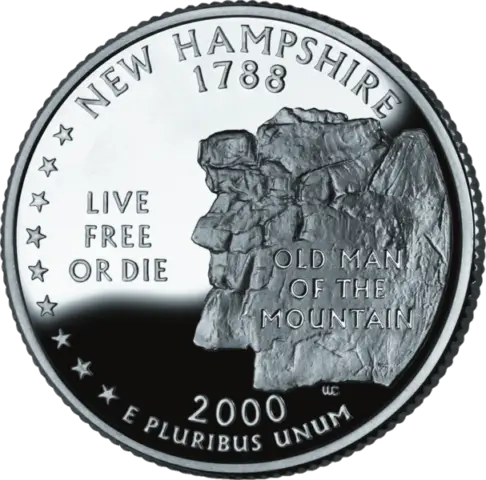 Some years ago, the U.S. Mint put out a series of commemorative quarters, one per state, and each state was allowed some freedom to present a design for the reverse of the quarter that symbolized the state. The state quarter for New Hampshire depicts the Old Man of the Mountain, a granite outcropping from Cannon Mountain composed of a series of ledges that, viewed in profile, resemble an old man's face.
The Old Man of the Mountain collapsed in 2003, so it is no longer available to be seen in person. Unlike Mount Rushmore, which includes manmade carvings of the heads of four presidents, the Old Man of the Mountain was an entirely natural landform. It takes imagination and pattern-recognition to be able to "see" the face.

Another image made the rounds on social media a few years ago. A large American flag was erected in the parking lot of a Fry's grocery store in Yuma, Arizona, suspended between two cranes, on September 12, 2001. Backlit by the rising sun, the flag was partially translucent, and it gave the impression of a Christian cross within the flag's blue field. This image was said to be symbolic of the U.S. being "one nation under God."
 If you'll permit me one more example from social media, I'll get to the point. A photo made the rounds on Facebook about the time that the movie American Sniper was in theaters. The photo is of a cumulonimbus cloud in the distance, perched over a mountainous horizon, and it is not difficult to see in that cloudform a sniper looking through a scoped rifle.
None of these images are anything more than coincidence and perception, of course. The cross-flag in particular is simply the product of back-lighting a woven fabric, plus an eager Christian looking for symbols that meet his or her prejudices. (If the shape of the weave had produced a crescent, do you think this person would have reached a similar conclusion about Islam?)
I have spent a great deal of time lately thinking about why it is that people are so eager to conclude that there is a God that intervenes frequently in our lives. It is relatively easy to see that rock outcroppings and the Moon don't really have human faces, or that a cloudform isn't actually a sniper or a frog or a rabbit. But what of the folks who claim, in all seriousness, that God is responsible for everything that happens in our lives, from the mundane ("I found a twenty-dollar bill in my coat pocket! Thank God!") to the serious ("My child was in a car hit by a drunk driver and in critical condition. Please pray for her")? What makes that concept so attractive to people, when there doesn't seem to be anything more than random chance at work?
I have to conclude that this is the result of a craving for patterns. We crave a deterministic universe, where known stimuli produce known results, where we can push this or that lever, metaphorically speaking, and get this or that predictable result. We fear the unknown, so we find comfort in the hope that someone--someone powerful, whom we imagine to be on our side--is really in control and working for our benefit.
If something bad happens, we can hope that the consequences will be somehow mitigated. My mother has cancer. Please pray for her healing.
If something good happens, we can attribute it to this mysterious force that loves us. I got a new job today, so thanks for your prayers--they really worked.
There is no bigger unknown than death. If you do this thing, then death won't really be the end of you, and you will live in a paradise unlike you've ever known.
This concept dominates most of the religions I have ever learned about. Judaism is one religion, at least in its modern practice, that doesn't seem to be dominated by it, but it is nonetheless a significant component of that religion. Christianity, particularly evangelical Christianity, is so thoroughly subsumed by this concept that virtually nothing else matters.
Why do these people in particular spend so much time attempting to divine the "will of God" based on what happens? Is the idea that bad things and good things happen because of the circumstances of their occurrence, and not because someone is behind the scenes pushing and pulling levers, really so frightening?
Some of you might be thinking, well, what could it hurt? And I get that. I can't definitively say that there is no God. I can only say that I have never seen any real evidence of one. If one exists, there are a lot of unresolved contradictions that don't seem to have a solution. But it turns out that it can hurt. Wishing that there were a God to save us from misfortune, from pain, from death, doesn't make it so. Concluding that misfortune, pain, or death is the result of lacking God's favor, when in reality those things are just random occurrences--well, that is harmful, psychologically. Trusting in God to save you when your own action would be more likely to do so--that's harmful. Praying instead of doing--that's harmful.
One of my favorite things to say--something I'll expand on a bit, today--is that even though we live in a universe that is capable of crushing us without a second thought, even though our world is fraught with perils, the likes of which we cannot even really begin to perceive, the major cause of our misfortune has nothing to do with these things in most cases. Sure, we might not know what precisely causes someone to get cancer and someone else not to. But there are many things that are capable of killing us, that don't, and we live out our merry lives in blissful ignorance.
What often causes us the most pain, the most strife, the most heartache, the most loss, isn't what we don't know. It's the thing of which we are absolutely sure, that simply isn't so. That's what kills you, literally or figuratively.*
* - One of my favorite examples of this is the insistence on the part of many evangelical Christians that humans could not possibly be responsible for global warming, because, they conclude, God would not allow us to destroy His creation. Because they are so absolutely sure of this, they believe it's unnecessary to do anything to counteract the global warming we're actually observing, even though it will almost certainly lead to devastating consequences for millions if not billions of people.
The late Christopher Hitchens, an avowed atheist, famously stated, "Religion poisons everything." He was right. There are lots of people who are supposedly inspired by their religion to do good works. When a Christian does something great or helpful for his fellow human, he and we are quick to attribute it to the powerful force of religion in his life. But I doubt very seriously that if you subtracted Christianity from the equation, it would make this great or helpful thing less great or less helpful, or that it would be the great or helpful thing disappear entirely--and if it did disappear entirely, what does it say about this supposedly great human being? That he can't be bothered to do right by his fellow human beings except on promise of some reward in the afterlife?
The truth is that we do the things that we do because we see them as right, on balance; then we fix the reasons around them as needed. Very few people do knowing wrong. They may do wrong, knowing that it is abstractly wrong, but justifying it by some greater good that they perceive, even if it's a personal good.
As most of you know, I enjoy playing pub trivia. I have been fortunate enough to win with some regularity. On at least two occasions, I have been credited with more points than I actually earned. I have polled some of my friends about that situation. Some of them say they would correct the score, even if it put them in a worse position. Some of them say they would keep their mouths shut.
When it happens, as it does from time to time, my decision has always been to give back the points. I have my reasons--take your pick: I win often enough without help that I don't need "help" when it comes like that; it's not fair to the other teams; if someone else got that sort of advantage over me, I'd want them to give the points back. But I could just as easily conclude that few people would give back points; that I'm handicapping myself not to take the "help" when it's my "turn," as it randomly would be from time to time; or that I simply like winning. I can't say that any of these reasons, pro or con, is inherently wrong. I can't say that pushing or pulling any given lever produces the "right" result.
But what I can say is that you can inject religion into that situation all you like, and it's not going to resolve the question. We might apply the Golden Rule, that principle common to all religions, but we might also conclude, with equal evidence and force and sincerity, that if God didn't want us to win, He wouldn't have allowed the mistake to be made.
And that's one of the more pernicious ways that religion, or at least this concept of an intermeddling God, this indecipherable pattern-maker, poisons things--by convincing us that everything happens for a reason, according to a pattern or plan, and who are we to question the good fortune we've had?
Taken to the extreme, we can see it in the modern evangelists' fundraising, whether it's Oral Roberts claiming that God commanded him to kill himself if he didn't raise $8 million for a new building, or Creflo Dollar seeking $65 million for a private jet, or Joel Osteen preaching that prosperity is a gift that God bestows upon the righteous.
God didn't want Oral Roberts to have a new building; Oral Roberts wanted a new building, and pretending that God wanted it on pain of Roberts's death was just the mechanism for getting there.
God didn't want Creflo Dollar to have a $65 million plane; Creflo Dollar wanted a $65 million plane; God was just the mechanism for getting it.
God doesn't give prosperity in exchange for righteousness. Joel Osteen wants a 10,000-square-foot house and a plane and fancy cars, and rich people want to be told that they deserve what they have, so they buy Osteen a big house and a plane and fancy cars.
God doesn't save your grandma from cancer; that's a surgeon or an oncologist, or maybe she won't be saved at all.
God doesn't heal the hole in your baby's heart; that's a cardiologist, or maybe your baby's body heals itself, or maybe she won't be healed.
God didn't put that $20 bill in your winter coat; you did, last spring, when you put it up for the last time, and forgot about it.
And God doesn't help you find your car keys, or put cross symbols in flags, or get you a new job. These things happen by chance. Or because you work hard and educate yourself. Or because you hit on that combination of things that produces the result you want.
And when you die, that's it. God isn't there to tell you, "OK, just kidding, here's eternal life."
So don't waste the life you have looking for patterns.
There aren't any patterns, not of this type. And seeing them, or being able to see them, doesn't mean they exist.
CODA: It's not that I see no use for religion. We humans are fragile. We are capable of so much, but we are equally capable of being taken down by our own foibles and follies. If you need religion to cope with the overwhelming reality of life, then, by all means, have religion. If you need to make a pattern that includes you not drinking or doing drugs, or otherwise engaging in destructive behavior, and religion helps you do that, I'm not going to stand in your way. But most folks would do just fine without it, and plenty of folks don't do well with it. So if you can be good without God, go ahead.
You might call that a failure of imagination, or it might be something else--maybe just an unwillingness to pretend to see things that weren't there.
One of the most famous commercial failures in history was the Edsel, not a single model of the Ford Motor Company, but its own division, much like Mercury and Lincoln, and four models. Edsels were fine enough cars--they did suffer from reliability issues mostly stemming from the division's innovative but underthought or underexecuted engineering--but they failed to sell and nearly took Ford straight out of business. The failure of the Edsel has been the subject of much study. One leading theory has to do with the vehicles' styling, particularly the front-end grille. The novel shape of the grille, internally at Ford referred to as the "horse collar" design, reminded folks of a rather different shape: female genitals.
 |
| As the joke went, "Put a little hair around it and you'd have an "Ethel." |
Vulgarities aside, we can look at the front of most cars these days and see a "face," of course. But why?
One of the continually amazing aspects of the human brain is its ability to engage in pattern recognition. In fact, that might be the single most important aspect of our evolutionary development.
If you show a dog a cartoon drawing of a dog, the dog won't recognize it as a dog. If you show the same dog a photograph of a dog, there is a fair chance that the dog will recognize the image as being that of a dog.
Show a person a cartoon drawing of a dog--even the most dull-witted of people, and even young children--and that person will recognize it as a dog. Our human brains are highly capable, almost instinctively, of the sort of analysis that's necessary to analogize a cartoon drawing to a real-life dog, because our brains are conditioned through millions of years of evolutionary development to make judgments about what sort of thing we are perceiving even though we may have only directly perceived a limited amount of information about it.
That ability confers an evolutionary advantage in a dangerous world for a couple of reasons. Being able to perceive dangers quickly enough to avoid them, even with limited information, means that those with this ability are more likely to survive to reproduce. Being able to use limited information to identify food sources or to identify members of your own social group does much the same thing.
The Old Man of the Mountain collapsed in 2003, so it is no longer available to be seen in person. Unlike Mount Rushmore, which includes manmade carvings of the heads of four presidents, the Old Man of the Mountain was an entirely natural landform. It takes imagination and pattern-recognition to be able to "see" the face.
Another image made the rounds on social media a few years ago. A large American flag was erected in the parking lot of a Fry's grocery store in Yuma, Arizona, suspended between two cranes, on September 12, 2001. Backlit by the rising sun, the flag was partially translucent, and it gave the impression of a Christian cross within the flag's blue field. This image was said to be symbolic of the U.S. being "one nation under God."
None of these images are anything more than coincidence and perception, of course. The cross-flag in particular is simply the product of back-lighting a woven fabric, plus an eager Christian looking for symbols that meet his or her prejudices. (If the shape of the weave had produced a crescent, do you think this person would have reached a similar conclusion about Islam?)
I have spent a great deal of time lately thinking about why it is that people are so eager to conclude that there is a God that intervenes frequently in our lives. It is relatively easy to see that rock outcroppings and the Moon don't really have human faces, or that a cloudform isn't actually a sniper or a frog or a rabbit. But what of the folks who claim, in all seriousness, that God is responsible for everything that happens in our lives, from the mundane ("I found a twenty-dollar bill in my coat pocket! Thank God!") to the serious ("My child was in a car hit by a drunk driver and in critical condition. Please pray for her")? What makes that concept so attractive to people, when there doesn't seem to be anything more than random chance at work?
I have to conclude that this is the result of a craving for patterns. We crave a deterministic universe, where known stimuli produce known results, where we can push this or that lever, metaphorically speaking, and get this or that predictable result. We fear the unknown, so we find comfort in the hope that someone--someone powerful, whom we imagine to be on our side--is really in control and working for our benefit.
If something bad happens, we can hope that the consequences will be somehow mitigated. My mother has cancer. Please pray for her healing.
If something good happens, we can attribute it to this mysterious force that loves us. I got a new job today, so thanks for your prayers--they really worked.
There is no bigger unknown than death. If you do this thing, then death won't really be the end of you, and you will live in a paradise unlike you've ever known.
This concept dominates most of the religions I have ever learned about. Judaism is one religion, at least in its modern practice, that doesn't seem to be dominated by it, but it is nonetheless a significant component of that religion. Christianity, particularly evangelical Christianity, is so thoroughly subsumed by this concept that virtually nothing else matters.
Why do these people in particular spend so much time attempting to divine the "will of God" based on what happens? Is the idea that bad things and good things happen because of the circumstances of their occurrence, and not because someone is behind the scenes pushing and pulling levers, really so frightening?
Some of you might be thinking, well, what could it hurt? And I get that. I can't definitively say that there is no God. I can only say that I have never seen any real evidence of one. If one exists, there are a lot of unresolved contradictions that don't seem to have a solution. But it turns out that it can hurt. Wishing that there were a God to save us from misfortune, from pain, from death, doesn't make it so. Concluding that misfortune, pain, or death is the result of lacking God's favor, when in reality those things are just random occurrences--well, that is harmful, psychologically. Trusting in God to save you when your own action would be more likely to do so--that's harmful. Praying instead of doing--that's harmful.
One of my favorite things to say--something I'll expand on a bit, today--is that even though we live in a universe that is capable of crushing us without a second thought, even though our world is fraught with perils, the likes of which we cannot even really begin to perceive, the major cause of our misfortune has nothing to do with these things in most cases. Sure, we might not know what precisely causes someone to get cancer and someone else not to. But there are many things that are capable of killing us, that don't, and we live out our merry lives in blissful ignorance.
What often causes us the most pain, the most strife, the most heartache, the most loss, isn't what we don't know. It's the thing of which we are absolutely sure, that simply isn't so. That's what kills you, literally or figuratively.*
* - One of my favorite examples of this is the insistence on the part of many evangelical Christians that humans could not possibly be responsible for global warming, because, they conclude, God would not allow us to destroy His creation. Because they are so absolutely sure of this, they believe it's unnecessary to do anything to counteract the global warming we're actually observing, even though it will almost certainly lead to devastating consequences for millions if not billions of people.
The late Christopher Hitchens, an avowed atheist, famously stated, "Religion poisons everything." He was right. There are lots of people who are supposedly inspired by their religion to do good works. When a Christian does something great or helpful for his fellow human, he and we are quick to attribute it to the powerful force of religion in his life. But I doubt very seriously that if you subtracted Christianity from the equation, it would make this great or helpful thing less great or less helpful, or that it would be the great or helpful thing disappear entirely--and if it did disappear entirely, what does it say about this supposedly great human being? That he can't be bothered to do right by his fellow human beings except on promise of some reward in the afterlife?
The truth is that we do the things that we do because we see them as right, on balance; then we fix the reasons around them as needed. Very few people do knowing wrong. They may do wrong, knowing that it is abstractly wrong, but justifying it by some greater good that they perceive, even if it's a personal good.
As most of you know, I enjoy playing pub trivia. I have been fortunate enough to win with some regularity. On at least two occasions, I have been credited with more points than I actually earned. I have polled some of my friends about that situation. Some of them say they would correct the score, even if it put them in a worse position. Some of them say they would keep their mouths shut.
When it happens, as it does from time to time, my decision has always been to give back the points. I have my reasons--take your pick: I win often enough without help that I don't need "help" when it comes like that; it's not fair to the other teams; if someone else got that sort of advantage over me, I'd want them to give the points back. But I could just as easily conclude that few people would give back points; that I'm handicapping myself not to take the "help" when it's my "turn," as it randomly would be from time to time; or that I simply like winning. I can't say that any of these reasons, pro or con, is inherently wrong. I can't say that pushing or pulling any given lever produces the "right" result.
But what I can say is that you can inject religion into that situation all you like, and it's not going to resolve the question. We might apply the Golden Rule, that principle common to all religions, but we might also conclude, with equal evidence and force and sincerity, that if God didn't want us to win, He wouldn't have allowed the mistake to be made.
And that's one of the more pernicious ways that religion, or at least this concept of an intermeddling God, this indecipherable pattern-maker, poisons things--by convincing us that everything happens for a reason, according to a pattern or plan, and who are we to question the good fortune we've had?
Taken to the extreme, we can see it in the modern evangelists' fundraising, whether it's Oral Roberts claiming that God commanded him to kill himself if he didn't raise $8 million for a new building, or Creflo Dollar seeking $65 million for a private jet, or Joel Osteen preaching that prosperity is a gift that God bestows upon the righteous.
God didn't want Oral Roberts to have a new building; Oral Roberts wanted a new building, and pretending that God wanted it on pain of Roberts's death was just the mechanism for getting there.
God didn't want Creflo Dollar to have a $65 million plane; Creflo Dollar wanted a $65 million plane; God was just the mechanism for getting it.
God doesn't give prosperity in exchange for righteousness. Joel Osteen wants a 10,000-square-foot house and a plane and fancy cars, and rich people want to be told that they deserve what they have, so they buy Osteen a big house and a plane and fancy cars.
God doesn't save your grandma from cancer; that's a surgeon or an oncologist, or maybe she won't be saved at all.
God doesn't heal the hole in your baby's heart; that's a cardiologist, or maybe your baby's body heals itself, or maybe she won't be healed.
God didn't put that $20 bill in your winter coat; you did, last spring, when you put it up for the last time, and forgot about it.
And God doesn't help you find your car keys, or put cross symbols in flags, or get you a new job. These things happen by chance. Or because you work hard and educate yourself. Or because you hit on that combination of things that produces the result you want.
And when you die, that's it. God isn't there to tell you, "OK, just kidding, here's eternal life."
So don't waste the life you have looking for patterns.
There aren't any patterns, not of this type. And seeing them, or being able to see them, doesn't mean they exist.
* * * * *
CODA: It's not that I see no use for religion. We humans are fragile. We are capable of so much, but we are equally capable of being taken down by our own foibles and follies. If you need religion to cope with the overwhelming reality of life, then, by all means, have religion. If you need to make a pattern that includes you not drinking or doing drugs, or otherwise engaging in destructive behavior, and religion helps you do that, I'm not going to stand in your way. But most folks would do just fine without it, and plenty of folks don't do well with it. So if you can be good without God, go ahead.
Subscribe to:
Posts (Atom)